Everything on this page was computed for Portland and nowhere else: the problem ranking from its Census housing profile, the seasonal risks from its NOAA station record, the coverage from its own ZIP codes. VoltReach USA connects you to an independent local electrician; the page itself is the homework, done in public, so the call you make is an informed one.
82
ZIP codes covered
3
Counties in the metro
236,428
Households (Census ACS)
1977
Median year home built
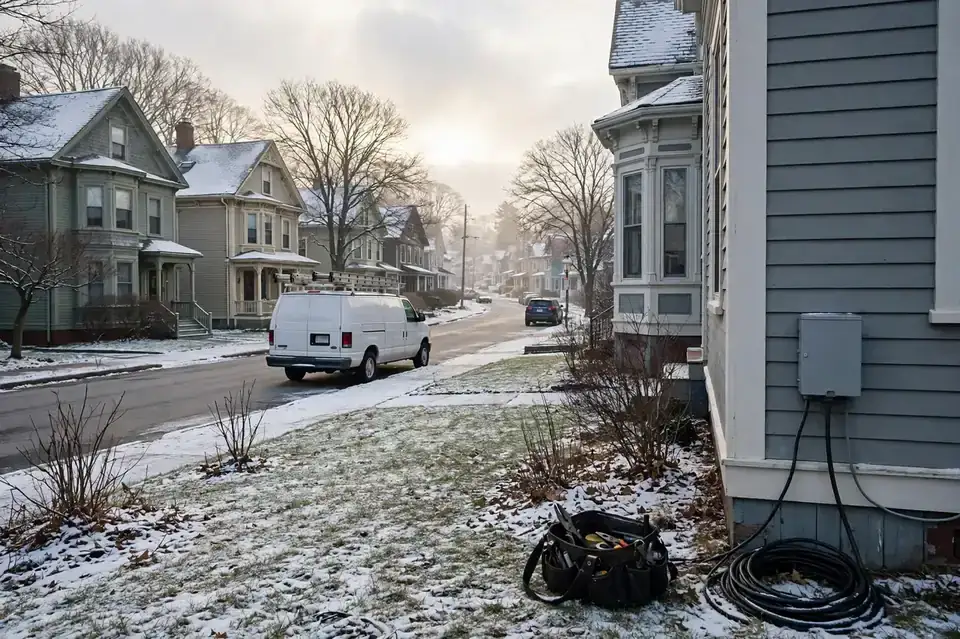
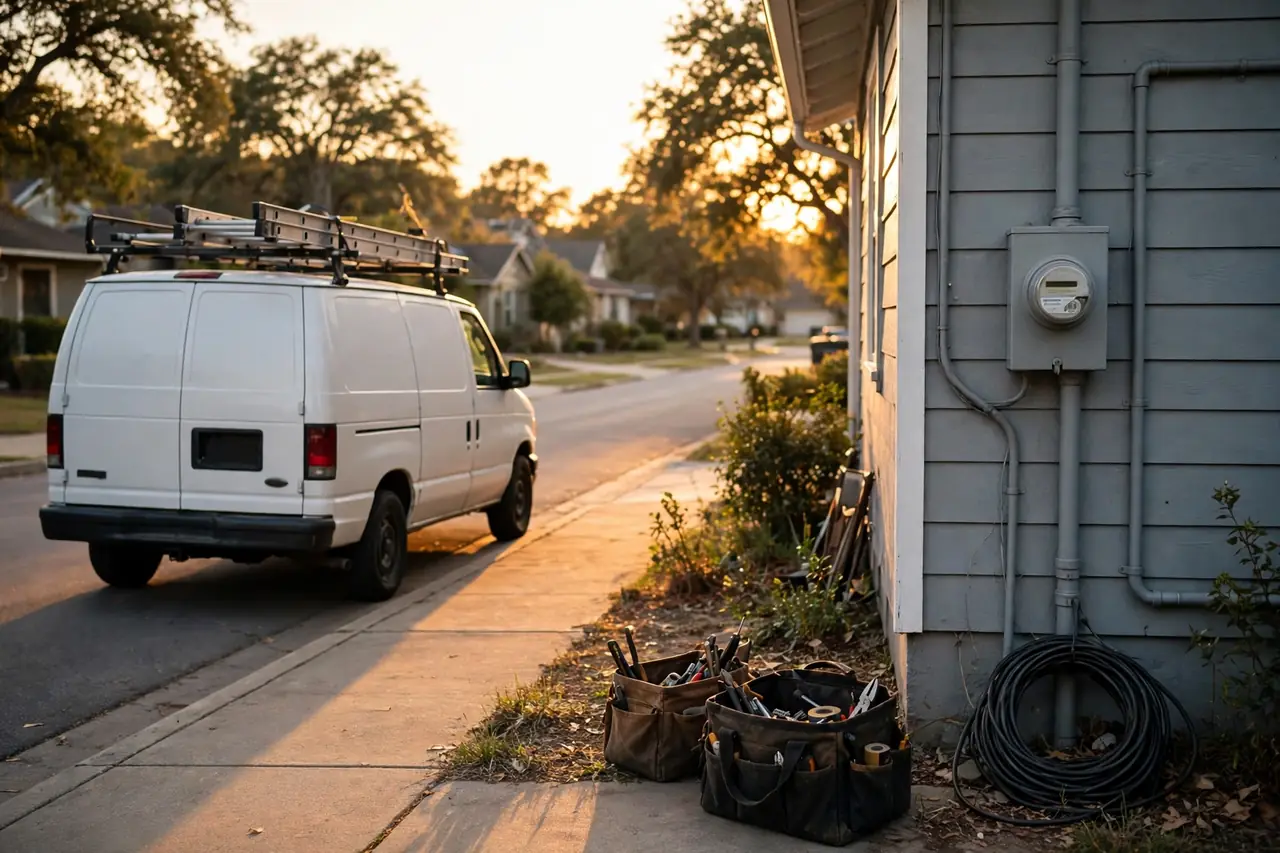
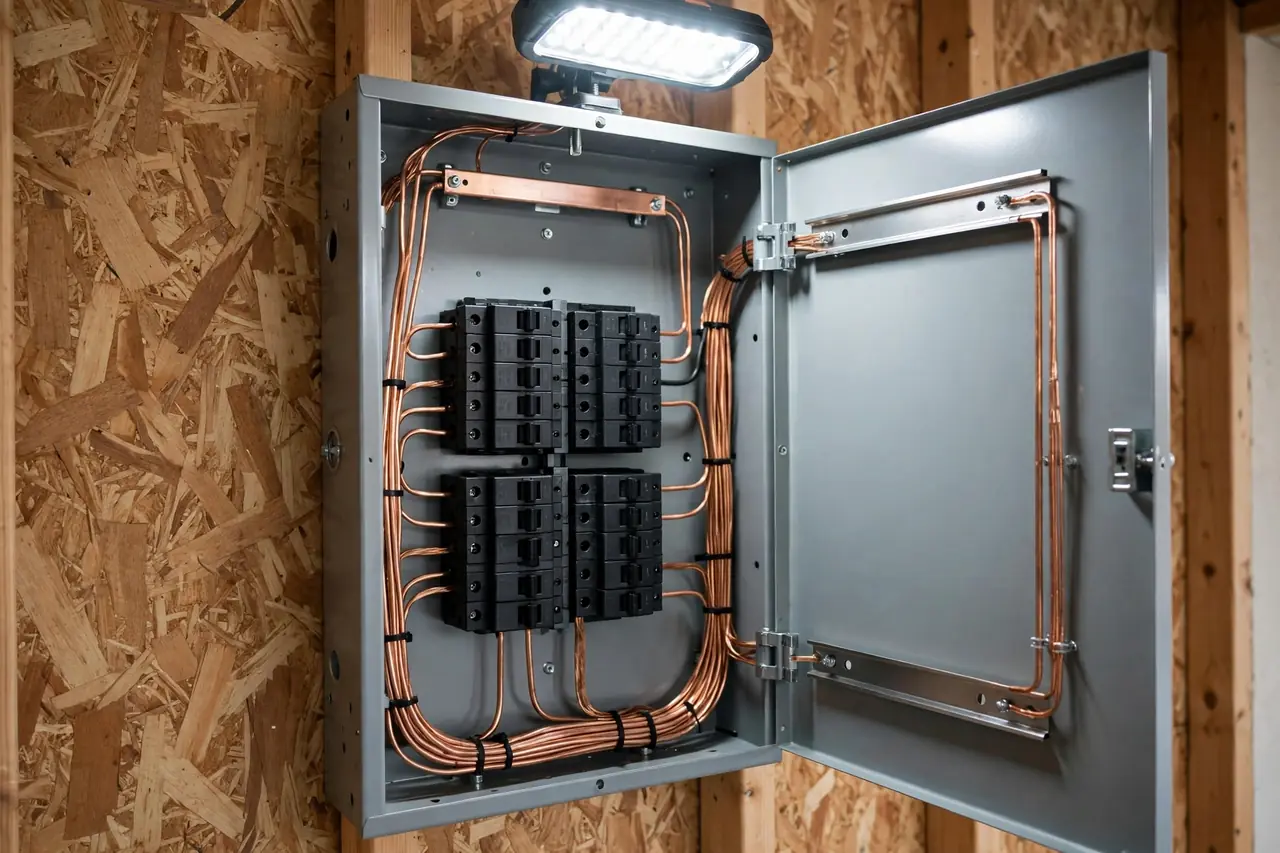
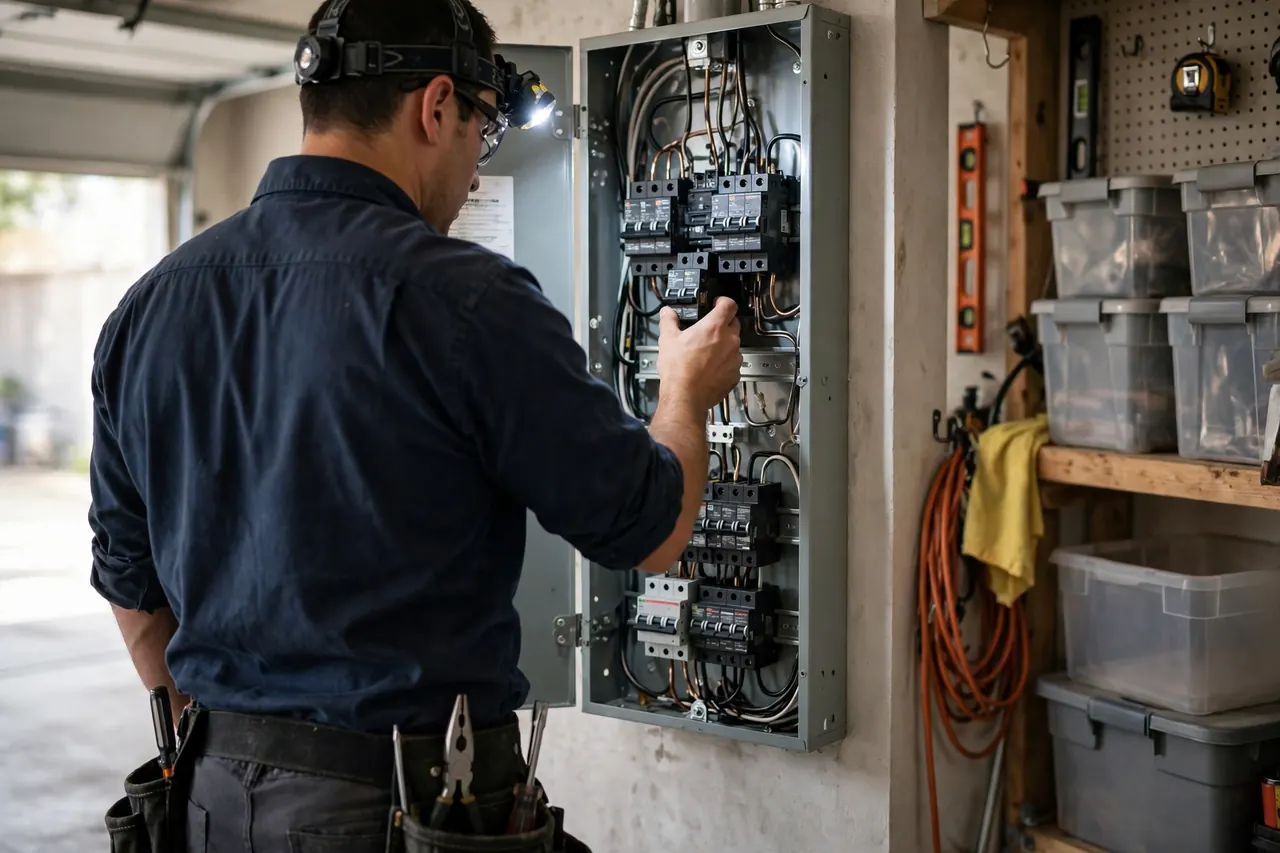
Portland, ME — electrical help across the metroA service van between calls in PortlandUpgrading a panel in a Portland home
Portland electrical work, in brief
The median Portland home was built in 1977; 53.8% of the stock predates 1980, and the pattern this metro's own data ranks first is heating load strain in portland. VoltReach USA is a referral service, not an electrical company: one call connects you with an independent local electrician serving your ZIP code.
The Portland housing stock, and what it means for wiring
Read Portland through its counties and the picture sharpens. Cumberland, Sagadahoc, York were not built in the same decades or for the same households, and their wiring carries those differences: an older core where 34.6% of the metro's homes predate 1960, growth corridors where the subdivisions arrived in waves, and edges still being built out. The metro-wide medians — a middle home built in 1977, 284,481 housing units in all — are the average of those local stories, and the sections below are organised by the patterns the combined record produces, from the oldest wiring generations to the newest failure modes.
By now, most of Portland's pre-1980 homes are on their second electrical lives in part: a panel replaced, a heavy-up done for a remodel, a run of new circuits for a kitchen — while the remainder of the original system carries on into its sixth and seventh decades. The 153,051 homes in that stock are therefore not uniformly old; they are individually old, each with its own archaeology of repairs. That is why the pre-1980 districts reward inspection over inference: the street's average says little about the house in front of you, whose real history is written in its panel directory and its junction boxes.
There is a second way to read the growth figures: as a maintenance wave still approaching. The 59,741 homes built since 2000 were handed over with everything new at once — panels, breakers, detectors, devices — and new things age in convoy. The first replacements in those subdivisions have begun; the wave behind them is arithmetic. Households in South Portland and the other growth districts who learn their systems now, while the systems are still young, are the ones who will meet that wave as a schedule rather than a surprise.
The weather's part in this is written at PORTLAND INTL JETPORT, ME US, where an average year carries 48.12 inches of precipitation, 5.1 days at ninety degrees or more and 144.1 nights at freezing or below. Electrical systems experience that year as workload and as hazard in roughly equal measure — the workload in the HVAC load on the panel, the hazard in the storm seasons and the deep-freeze nights. The problem ranking further down is simply the housing profile above, read under this sky.
The Portland electrical profile in numbers
Two public records, one metro: what was built here, and what the sky does to it.
The distribution, in one breath: of every hundred Portland homes, 34.6 were standing before 1960, 19.2 went up in the two decades after, 25.2 in the two after that, and 21.0 have arrived since 2000. Percentages flatten the picture, so hold the counts beside them — 98,430 oldest-era homes, 59,741 newest — and the metro's electrical systems stop being an abstraction: that many panels, that many wiring generations, ageing in that order.
Look at Portland through its oldest homes and the electrical picture sharpens. With 98,430 homes built before 1960, neighbourhoods in Portland and South Portland contain panels that began as fuse boxes, services that were small by design and wiring installed before grounding was routine. Successive owners in Cumberland have added circuits, replaced sections and adapted rooms, so a single house may hold three generations of work. That layered history is the central electrical characteristic of Portland, Maine: not one system but many, house by house, which is why independent local electricians assess each property individually rather than assuming a street shares one condition. Across the wider metro, that pattern repeats in smaller pockets wherever this era clusters, giving independent local electricians a recognisable starting point before they examine the individual system in front of them.
Housing from 1980 to 1999 is the second-largest presence in Portland, 71,689 homes spread through Portland, South Portland and Biddeford. Electrically these are transitional homes in a useful sense: copper wiring and breaker panels throughout, ground-fault protection beginning in wet areas, but capacities of 100 to 150 amps that modern loads press against. In Cumberland, this band often produces the most straightforward assessments in Portland, Maine, because the systems are coherent and documented by their era, with age and added demand, rather than obsolete methods, as the main considerations. Streets in Sanford built in this wave are a familiar sight during breaker and capacity assessments across the working week.
Freeze nights deserve their own place in the Portland climate profile, because they load the system in a distinctive way. On the 144.1 days at or below freezing at PORTLAND INTL JETPORT, ME US, heating runs continuously, auxiliary heat adds heavy draw, and households in South Portland and Biddeford supplement with space heaters on ordinary circuits. The 6,795 heating degree days behind those nights explain why panels in Portland that seem adequate in autumn can trip in January. Independent local electricians in Cumberland weigh that winter peak alongside the summer cooling peak of 447 degree days when they assess a Portland, Maine home as a whole. For planning, the useful question is not whether a system copes today, but whether it copes on the hardest local day of its year.
For a homeowner in Portland, the practical value of this ranking is sequence. It suggests which checks come first for a home of a given era in this climate, whether that is panel condition before summer in South Portland, heating circuits before winter in Portland, or grounding and protection ahead of storm season in Biddeford. Across 236,428 households in Cumberland, the order differs by era and exposure, and independent local electricians can turn this metro-level picture into a home-specific order of attention for any property in Portland, Maine.
Electrical services in Portland
Listed in the order this metro's housing and climate data supports.
Emergency Electrician in Portland
Shocks, exposed wiring, or arcing in Portland homes across 82 ZIP codes are reasons to keep people away and seek help. VoltReach USA connects you with an independent local electrician who talks through precautions and next steps directly.
Electrical emergencies in Portland often trace back to the age of the system involved. A metro with 153,051 homes built before 1980, 34.6 of them before 1960 and a median year of 1977 will naturally see ageing panels, older wiring and decades of modifications meeting present-day demand. When that meeting produces sparking, smoke, a burning smell or a sudden loss of power to part of a home in Portland, South Portland or Biddeford, homeowners need a calm assessment. Independent local electricians can make the situation safe, isolate the affected circuit in a Portland home and explain what happened in plain terms. Keeping torches, rather than candles, within reach in Sanford is a small preparation that makes a dark house safer during any outage. Across 82 ZIP codes in Portland, Maine, homeowners who start with a clear evaluation, grounded in the age of the property and its 1977 era context, are well placed to decide what should happen now and what can be planned for later with independent local electricians.
Urgent faults in Portland arise from a stock where 153,051 homes predate 1980 and the median build year is 1977, spread across 82 ZIP codes in 3 counties. Ageing systems meeting modern load is the recurring local pattern in Cumberland. Independent local electricians can make a Portland, Maine home safe, isolate the fault and explain the likely role of the system's age and condition.
In Portland, rewiring questions usually start room by room: a kitchen in Portland, a nursery in South Portland, an office where grounded outlets matter. Independent local electricians can map the existing circuits and explain a sensible order of work. The findings are usually mapped circuit by circuit, so owners can see which rooms come first and which sound runs can stay in service longer.
Weather shapes how hard wiring works in Portland, Maine. At PORTLAND INTL JETPORT, ME US, the record shows 47.5 as the average temperature, 48.12 of annual precipitation, 144.1 days at or below freezing and 5.1 hot days, a mix that drives heating, cooling and ventilation loads for much of the year. Circuits that carry space heaters in winter and air conditioning in summer accumulate hours quickly, and older insulation on conductors in hot attics ages faster. Across 236,428 households, rewiring enquiries often follow seasons of heavy use. Independent local electricians can assess attic and wall conditions in Portland homes and discuss where renewed wiring would most improve reliability under that local climate load. Households in Biddeford sometimes phase the work floor by floor, keeping part of the home fully usable while sections are renewed. The 6,795 heating degree days and 447 cooling degree days recorded for Portland mean its homes work hard in both directions, so independent local electricians will usually ask about seasonal behaviour before recommending how a job in Portland should be approached.
The Portland climate recorded at PORTLAND INTL JETPORT, ME US includes 144.1 days at or below freezing, 5.1 hot days and 48.12 of precipitation annually. Wiring in Portland attics and walls experiences those extremes every year, and insulation on older conductors ages accordingly. Independent local electricians can weigh exposure and age together when assessing rewiring priorities for a home in Cumberland, Sagadahoc, York.
Households in Portland, Maine dealing with Heating Load Strain in Portland or knob-and-tube wiring in Portland during outages often want a permanent answer rather than extension cords. Independent local electricians can size a system around the circuits that matter to you. Discussing those needs openly at the start helps the electrician size the transfer equipment honestly, rather than selling capacity the household will never actually use.
A standby or portable generator plan in Portland begins with the age and layout of the homes it would support. Many houses built around 1977, including stock in Cumberland where 53.8 predates 1980, have panels, fuel arrangements and room layouts that shape where equipment can sit and what it can carry. Neighbourhoods in Portland, South Portland and Biddeford differ widely in lot size and panel location. Independent local electricians can assess a Portland home's essential circuits, panel configuration and placement options, then explain how a generator connection would be arranged for that property rather than in general terms that ignore its era and layout. Fuel type, storage and delivery access at a property in Sanford all enter the discussion alongside the electrical connection itself. Owner-occupiers, 73.1 of households in Portland, often plan electrical work alongside other projects, and independent local electricians can help sequence it sensibly for a property in Cumberland so walls are opened once and circuits are planned as a whole.
Housing age matters for generator placement in Portland: 153,051 homes built before 1980 and 71,689 built from 1980 to 1999 present varied panel locations and lot layouts across 82 ZIP codes. Independent local electricians can survey a Portland property in Cumberland, note panel configuration and clearances, and explain how transfer arrangements would fit that particular home rather than a generic layout.
In Portland, Maine, the panel question often arrives with a project: a kitchen update in South Portland, a workshop in Biddeford, or new equipment the old panel cannot support. Local electricians can assess the existing service and lay out the next step. Starting there keeps a later kitchen, laundry, or workshop project from stalling when the crew discovers the panel cannot support the plan midway through.
In Portland, Maine, the panel in the garage or utility room often tells the age of the house more honestly than any listing. With a median build year of 1977 and 53.8 of homes built before 1980, many properties in Cumberland still run on panels sized for a different era, when the 1970s construction set the pattern. Those 153,051 older homes were wired for lighting and a handful of appliances, not for layered modern demand. A panel upgrade, assessed by independent local electricians, is where homeowners in Portland, South Portland and Biddeford start when breakers feel warm, capacity feels tight, or a renovation is planned, because the panel has to be understood before anything new is added to it. Households in Biddeford often find that conversation clarifies whether a like-for-like replacement, added spaces or a larger service suits the property. From Portland to the newer streets near South Portland, the consistent advice in Portland is to understand the existing system first, and independent local electricians can provide that understanding for homes across 3 counties before any work is agreed.
At PORTLAND INTL JETPORT, ME US, Portland records 447 cooling degree days and 6,795 heating degree days, with 5.1 days at or above 90 degrees. Peak seasonal load is when panel capacity in Portland homes is tested hardest, especially in the 71,689 homes built from 1980 to 1999 whose panels are now decades old. Independent local electricians can factor that seasonal peak into an assessment.
In Portland, the distance from panel to garage and the panel's spare capacity shape every charging installation. Local electricians serving Portland and South Portland can measure both and explain your options.
One circuit keeps cutting out in Portland? VoltReach USA connects you with an independent local electrician who can separate a worn breaker from an overload and explain the next step.
In Portland, whole-home surge protection starts at the panel and covers hardwired equipment too. VoltReach USA connects you with an independent local electrician to discuss whether it fits your home.
Good lighting in Portland, Maine layers ambient, task, and accent light instead of relying on one ceiling fixture. VoltReach USA connects homeowners with independent local electricians who plan and install lighting in Cumberland.
A fan is only as good as its mounting and sizing. Homeowners in Portland use VoltReach USA to reach independent local electricians who match fan size to the room in Portland, South Portland, and across Cumberland.
In Portland, loose, warm, or crackling devices should be replaced, not tolerated. VoltReach USA connects you with an independent local electrician who can renew outlets and switches safely.
Old, chirping, or battery-only detectors in Portland can be upgraded to hardwired, linked units. VoltReach USA connects you with an independent local electrician to plan the change.
New equipment or a refit coming up in Portland, Maine? VoltReach USA refers businesses to independent local electricians who can plan dedicated circuits and lighting around the layout.
Bookings in this metro have a centre of gravity, and it sits on the two patterns this page ranks first: Heating Load Strain in Portland, then knob-and-tube wiring in Portland. Everything a local service operation does — the vans' stock, the week's scheduling, the order of this very list — bends around that gravity. A homeowner reading the services above is therefore reading something more specific than a menu: a forecast of what a home like theirs, in a metro built like this one, is most likely to need, in the order it is most likely to need it.
Electrical problems Portland homes actually get
Selected and ranked from this metro's housing-age profile and climate record — not copied from another city's page.
Heating Load Strain in Portland
Panels feel heating strain as a whole system in Portland, not just on the heating circuit. On a deep winter evening, heating, cooking, hot water, laundry and lighting peak together, and a service sized in an earlier era runs near its ceiling for hours. In homes among the 153,051 built before 1980 here, that sustained peak is when a main breaker may trip or a marginal connection finally fails. The pattern can look alarming — much of the house dark and cold at once — but its logic is the familiar overload logic at service scale. An electrician assessing a Portland home after such an event assesses total load against service size, the heating circuits first, and the condition of the main equipment, then explains whether redistribution, repair or a service upgrade is the proportionate answer.
Frozen building risks touch wiring indirectly in Portland, and a balanced page should place them correctly. The primary freeze threats are to plumbing, not conductors, but burst pipes and the water they release can reach outlets, panels and junction boxes in basements and crawl spaces in Biddeford, and heating failures that cause freezes often begin with the electrical supply to the heating system. Keeping heating circuits sound is therefore freeze protection in a real sense for a Portland home. After any freeze event involving water inside the structure, electrical equipment the water reached should be inspected before being trusted, exactly as after a flood in Cumberland.
The timing pattern is the telling evidence in Portland. Electrical failures here cluster in deep winter, often on the same few nights when the whole region is coldest. That is not coincidence; it is arithmetic under stress. A heat pump in Sanford that coped all autumn switches to auxiliary heat as temperatures fall, multiplying its draw. Space heaters appear in bedrooms in Saco on circuits that were quiet all summer. Every house on the street makes the same moves at once. Electricians serving Cumberland, Sagadahoc, York plan for those nights, because they know marginal panels and tired connections in Portland reveal themselves exactly when heating demand peaks and alternatives are fewest.
For buyers, sellers and long term owners in Portland alike, documentation changes the conversation. A written assessment that identifies which circuits are knob-and-tube, their condition, and what rewiring would involve converts an anxious unknown into a scoped project with a sequence. That is useful at a sale, useful when talking with an insurer, and useful simply for living in the house with a plan. VoltReach USA connects Portland homeowners with independent local electricians who assess older wiring in person. The goal is not to alarm anyone about a house in Portland or Biddeford. It is to replace assumption, in either direction, with a clear map of what is in the walls.
Planning a rewire in a Portland older home goes more smoothly when it is coordinated with the house's other needs. Rewiring while a room is being renovated, while ceilings are open for other work, or alongside a panel upgrade shares access and reduces repeated disruption to plaster and finishes that give older Portland homes their character. An electrician who has mapped the house can suggest an order that follows the load and condition findings: heaviest used and poorest condition circuits first, lighting only remnants later. Over one project or several, that map turns a century old wiring system into a finished, documented modern installation for the next owners of the house.
The oldest layer of Portland housing is substantial: Census data counts 98,430 homes built before 1960 — 34.6 of the stock — and the earliest of them in Portland, South Portland and Biddeford predate modern wiring methods entirely. Homes from before about 1950 in Cumberland were commonly wired with knob-and-tube, a system using separate single conductors run on ceramic knobs and through ceramic tubes. Where it survives in Portland, it survives in houses that have often been renovated room by room, leaving original wiring in the least disturbed places: attics, basements and wall cavities.
Surges at restoration are the quiet companion of outages in Portland, and they link this pattern to protection choices. When supply returns after a fault, voltage can overshoot briefly, and switching elsewhere on the network adds smaller surges over time. Modern Portland homes concentrate the equipment most sensitive to those events: HVAC control boards, appliance electronics, computers and entertainment systems. Point of use protectors help individual devices, while a whole home device at the panel addresses surges entering through the service. After a stormy season in Maine, many homeowners use the experience to assessment that layered protection with an electrician, turning a rough week into a concrete improvement before the next event.
Basement and garage circuits in Portland deserve a post storm routine of their own. After water has stood in a low area, receptacles and junctions at that level should be treated cautiously, not tested by plugging in equipment to see what happens. Drying out is not the same as being cleared, because residue and corrosion remain on contacts. An electrician inspecting after flooding in Cumberland will typically isolate affected circuits, open devices at the exposure level, and replace what water has compromised. That methodical response also produces documentation of storm damage to electrical equipment, which a Portland homeowner may need for other conversations after a major event.
Water and electricity set the third strand of evidence in Portland. Panels and outlets in garages, basements and exterior walls in Portland sit closest to driven rain and standing water. A panel that has taken in water may show rust, white corrosion on breakers, or staining long after the floor dries, and circuits fed through flooded areas can develop faults that appear weeks later. In a city recording 48.12 inches of rain a year, that slow evidence matters. An electrician assessing post storm problems in Portland will ask where water reached, because the honest answer directs the inspection to the boxes and devices most likely to have been compromised.
Not every old panel needs replacing, and age alone is not a diagnosis. Some older panels in Portland remain serviceable, correctly rated and in sound condition, while others show heat discoloration, corrosion, breakers that no longer trip reliably, or designs that have long been superseded. The distinction matters, and it cannot be made from the age of the house or a photograph of a closed cover. Independent local electricians serving Cumberland open the panel, inspect the internal condition, test where needed, and explain findings in plain terms. That inspection-first approach keeps a Portland homeowner from replacing sound equipment or, just as importantly, trusting equipment that should retire.
A load calculation is the useful starting point for any Portland panel question. It accounts for the square footage, major fixed appliances, heating and cooling equipment, and other significant loads, then compares the total with the existing service size. That comparison explains why two houses on the same Portland street can have different answers: one still uses gas for several major loads, while the other has converted to electric across the kitchen, laundry and heating. Without that calculation, advice about capacity is guesswork, and guesswork around a service panel is a poor basis for spending or for reassurance.
The numbers behind this pattern sit in the housing record for Portland. Of 284,481 housing units, 153,051 predate 1980, an era the data groups as the 1970s, and many were completed before breaker panels became roomy or spare circuits became expected. In Cumberland, where 73.1 of homes are owner occupied, that legacy equipment often stays in service through successive owners because it still powers the lights. Capacity problems tend to surface later, when a renovation, a charger or a new appliance asks for a circuit the panel has no room to give.
Watch for
Double tapped breakers visible on inspection
Rust or corrosion on the panel enclosure
Appliances that cannot run at the same time
Frequent trips on hot afternoons in {city}
Old panel brands flagged by your electrician for assessment
Home sale inspection notes raising panel questions
Long cold winters test a Portland home electrically like nothing else in the year. With 6,795 heating degree days and 144.1 days at or below freezing recorded at PORTLAND INTL JETPORT, ME US, heating systems run for hours without pause, heat pumps call on auxiliary strips, and space heaters appear in the coldest rooms of homes in Portland and South Portland. Panels and circuits that felt ample in October carry their heaviest sustained loads in January, and weak points — a loose termination, a tired breaker — declare themselves on the coldest nights. A pre season check of heating circuits in Portland, plus a clear plan for generator readiness if outages threaten heat, turns deep winter from an annual gamble into a known, managed peak.
When sustained cold settles over Portland, the electrical system works differently. Heating equipment that cycles briefly in mild weather runs almost continuously, auxiliary strips add heavy draw during the coldest hours counted among 144.1 freezing days at PORTLAND INTL JETPORT, ME US, and households in South Portland and Biddeford add space heaters room by room. In homes built in the 1970s across Cumberland, that load lands on circuits planned for far less. Flicker when the heating starts and trips that happen only before dawn are useful clues. Independent local electricians can assess heating load and circuit condition in Portland homes during freeze season.
A closer look: heating load strain in portland in Portland
Auxiliary heat is the hidden multiplier in Portland winter loads, and a closer look at it explains many midwinter surprises. Heat pump systems are commonly sized so the heat pump carries the load in moderate cold, with electric strips staged to assist in deeper cold and to temper air during defrost cycles. Each stage that engages adds a substantial, sustained draw. The homeowner experience in Saco or South Portland is a system that behaved all through November and strains in the coldest week, drawing far more current in January than its nameplate habits suggested in autumn. An electrician evaluating winter trips in Portland will ask about the heating type and auxiliary arrangement early, check the circuits and breakers feeding each stage, and verify the panel can carry the combined household peak when all stages run. That combined peak — heating at full stage, water heating recovering, cooking underway — is the number the service must survive, and in many older Portland homes it has simply never been calculated.
Strip the pattern down to its inputs and the ranking stops being mysterious: 236,428 households drawing on systems installed across a median build year of 1977, in a climate that swings between 5.1 days of serious heat and 144.1 freezing nights. Whatever pattern a metro with those inputs manufactures most, it manufactures here — the lead position is less a title than a consequence, recalculated from the same public records any sceptic can check.
The first visit follows a short, diagnostic list — each item ruling a branch of the problem in or out:
Look for discoloration along the heating path
Verify main breaker condition under load history
Check circuits in the coldest rooms for overload
Assess generator coverage for heating essentials
Examine panel for signs of sustained heat
Advise on load staggering during cold snaps
From problem to fixed, in Portland
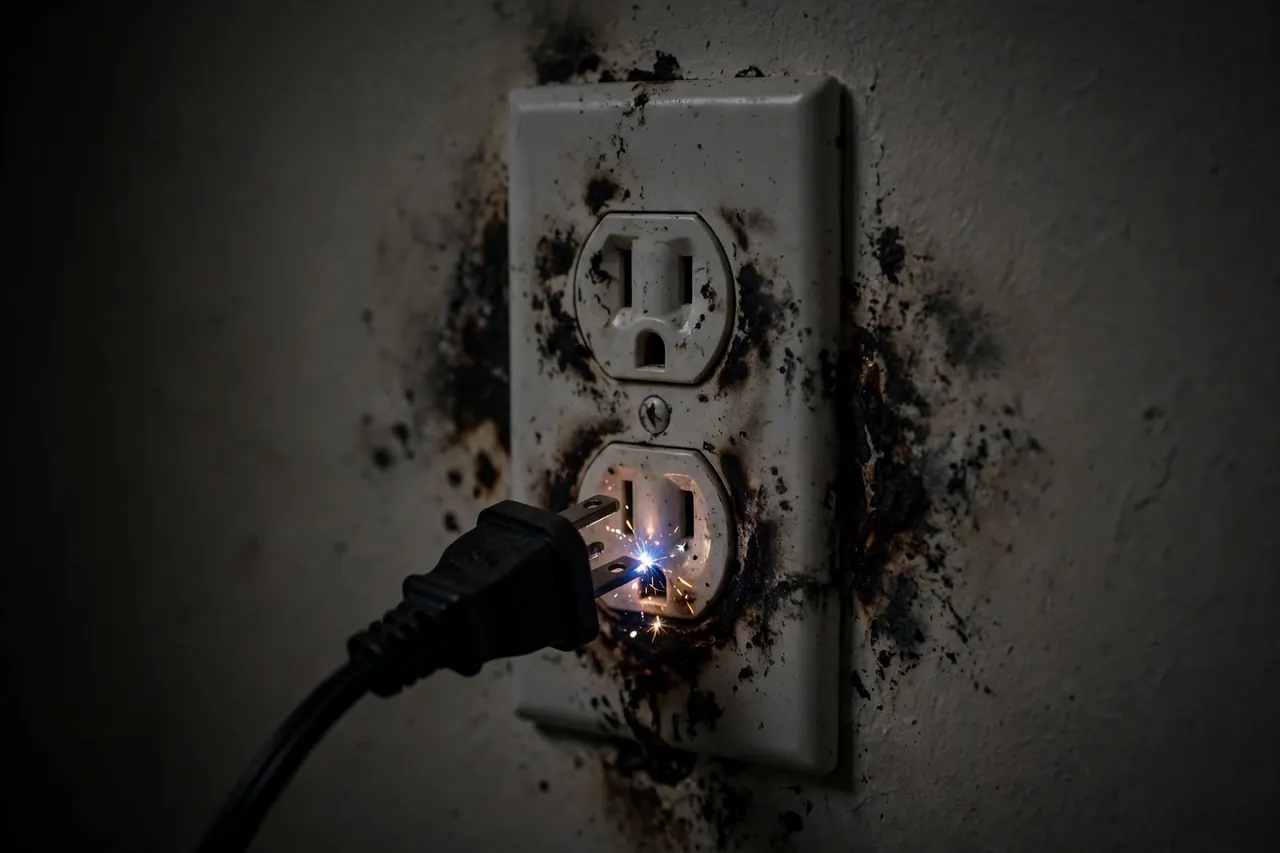
PROBLEMAn electrical problem inside a Portland home
➔
SOLUTIONThe same system in Portland after professional repair
Areas covered in the Portland metro
Portland
Population 68,505
South Portland
Population 26,780
Biddeford
Population 22,463
Sanford
Population 22,095
Saco
Population 20,636
Westbrook
Population 20,484
Brunswick
Population 16,928
Old Orchard Beach
Population 9,150
Bath
Population 8,801
Gorham
Population 7,365
Topsham
Population 6,962
Yarmouth
Population 6,293
Also in the Portland metro: Kennebunk (population 6,008), North Windham (population 5,633).
The communities in the grid are not suburbs of the page; they are its subject as much as Portland is. South Portland (26,780 residents) and Biddeford (22,463) carry their own building decades, their own panel generations and their own positions in the problem ranking's logic — a circuit under a South Portland street answers to the same data as one in the centre, but to a different era of it. Coverage here is defined by the ZIP list below; understanding is defined street by street, and this page's figures are the metro-wide version of a story each community tells in its own numbers.
Also on the Portland map: Sanford (22,095), Saco (20,636), Westbrook (20,484), Brunswick (16,928), Old Orchard Beach (9,150) — communities spread across Cumberland, Sagadahoc, York, each with housing from its own growth years. An electrician routed through VoltReach USA to any of them is working from this same page: the metro data does not change at the city limit, but the housing on your street — its age, its wiring, its panel — is what the visit is really about.
Portland (68,505 residents) anchors the metro, and South Portland (26,780) is its second centre of gravity. Between them they hold the bulk of the 236,428 households — and, not coincidentally, the bulk of every housing era this page discusses, from the pre-1960 core to the newest subdivisions. Biddeford (22,463) and the communities beyond it repeat the same eras at smaller scale.
One metro, 3 county lines drawn through it: Cumberland, Sagadahoc, York. The lines are invisible to the current and the weather, but they structure everything administrative around an electrical job — which office permits it, which inspector signs it, which code edition applies. Cumberland County, at the centre, carries the oldest housing and the heaviest share of the work this page describes; its neighbours carry the growth. A routed local electrician navigates the patchwork so the homeowner does not have to.
Beyond the metro line, the nearest covered metros are Bangor, ME (141 miles away), Boston, MA (89 miles) and Manchester, NH (91 miles) — separate pages, separate profiles, because their housing and weather records are their own. Homeowners near the boundary sit between two datasets; the ZIP list above, not the map's edge, decides which page was written about your stock.
Set Portland among its neighbours and the contrasts sharpen the profile: Bangor, ME — metro population 157,967, median build year 1977 — sits 141 miles away; Boston, MA (5,034,221, median 1963) 89 miles; Manchester, NH (433,415, median 1977) 91 miles. Three different housing stocks under three nearby skies, which is why each keeps its own page and its own problem ranking rather than borrowing this one.
Count the metro per unit of itself: 3,469 housing units per covered ZIP code; 78,809 households per county; 14 communities sharing 3 county governments. Then weigh the generations against each other — 2.6 older homes for each newer one — and the service pattern on this page stops being a list and becomes a proportion: that much of the diary written by ageing systems, the rest by young ones wearing in.
Portland by the derived numbers — median home age 49 years · owners in 172,829 homes, renters in 63,599 · each covered ZIP code carrying about 1,200 pre-1960 homes · a heating-to-cooling degree-day ratio of 15.22 · 1,222 mm average annual rainfall.
Portland electrical questions
How can I tell whether VoltReach USA covers my Portland, ME address?
The simplest test is to work through two lists on this page. First, look for your ZIP code among the 82 codes published for the Portland area. Second, confirm that your home is in one of the named counties: Cumberland, Sagadahoc, York, with Cumberland as the main county. If your code and your county both appear, this page covers you. VoltReach USA itself is the connection point only. It gathers the housing, weather and wiring context for Portland, Maine and passes your request to an independent local electrician. That electrician is the person who would attend, inspect your circuits and panel, and carry out any work. The population behind the boundary underlines its scale: 236,428 households in 284,481 homes across Cumberland, Sagadahoc, York, with 73.1% owner-occupied, means the coverage list is not a token gesture toward Portland but a working map of where local homeowners actually live, street by street and code by code, throughout the metro this page describes in its housing and weather research above. For the record in its most compressed form, 03901, 03902, 03903, 03904 open the code list for Portland, the era ledger runs from 98,430 pre-1960 homes onward, and the largest community, Portland, counts 68,505 residents within a metro population of 557,764 recorded for this page. Stated as the communities those codes contain: the community ledger reads Portland (68,505 residents), South Portland (26,780), Biddeford (22,463), Sanford (22,095) and Saco (20,636), out of 557,764 residents metro-wide. The coverage behind this answer spans ZIP codes 03901 through 03907 - the ZIP list published on this page. The footprint takes in York County, Cumberland County and Sagadahoc County - 3 covered counties in all, each with its own page on this site. All of it describes the Portland–South Portland metro as the Census defines it - 557,764 residents in 284,481 housing units. Run the same ranking for nearby Bangor and its leading pattern is heating load strain - a different order from Portland's, which is why this site keeps a separate page for every metro. Read it against a median build year of 1977 and a 53.8% share of homes from before 1980.
Which Portland, ME homes should watch their electrical systems most closely?
If your Portland home was built before 1980, put it in the close-watch group and keep it there. That group covers 153,051 homes locally, including 98,430 built before 1960. Those homes have commonly gained demand in layers: an added room here, a heavier appliance there, extra outlets worked into circuits that were modest at the start. The panel may look tidy while sitting near the edge of what its circuits can comfortably carry. Signs worth noting include breakers that need resetting more than rarely, lights that dip when a motor starts, outlets that have stopped working, and any burning smell near a switch or outlet. Noting the pattern, and when it happens, helps an electrician judge the system far faster. Across the wider metro the same pattern repeats from Portland through South Portland and Biddeford into the outer communities: the closer a neighbourhood sits to the historic core of Portland, the older its era profile tends to be, with 98,430 homes built before 1960 and 54,620 from 1960 to 1979 shaping the risk map far more than any single street, which is why this page reads age by area rather than treating Portland as one uniform stock. The ownership figures add a practical edge to the watch list, because with 73.1% of 236,428 households owning their homes in Portland, most of the older stock is looked after by the people living in it, and the panel and wiring decisions for 153,051 pre-1980 homes rest with those households directly, which makes an honest yearly watch a normal part of owning an older Portland home. In ledger form the priority is stark: 34.6% before 1960 and 19.2% from 1960 to 1979, set against a PORTLAND INTL JETPORT, ME US record of 144.1 freezing days and 5.1 hot days cycling those old circuits yearly, which is the whole argument for watching the oldest third of Portland housing closest. For the watch list stated as codes: the codes run 03901, 03902, 03903, 03904 and 03905 among the 82 on the list, spread over Cumberland, Sagadahoc, York. The housing ledger behind it counts 98,430 homes from before 1960 and 59,741 built since 2000 across the metro. Read it against a median build year of 1977 and a 53.8% share of homes from before 1980. Run the same ranking for nearby Boston and its leading pattern is heating load strain - a different order from Portland's, which is why this site keeps a separate page for every metro. The coverage behind this answer spans ZIP codes 03901 through 03907 - the ZIP list published on this page. The weather record behind it is PORTLAND INTL JETPORT, ME US's: 6,795 heating degree-days against 447 cooling degree-days in an average year.
What is the most common electrical problem in Portland, ME homes?
Ask what fails most in Portland and the data points to Heating Load Strain in Portland, followed by knob-and-tube wiring in Portland. The method behind that answer is set out on this page: housing-age figures from the Census, weather normals from the local station, and the known weak points of each wiring generation present in the stock. Where older homes dominate, panel capacity and circuit condition tend to lead. Where growth is newer, the order can shift toward wear in heavily used circuits and outdoor fittings. Your home may not follow the city pattern at all, and that is normal. Rankings describe a metro of 284,481 homes. They are a map of where attention usually pays off first, and a prompt to compare your own symptoms against the pattern. The third name on the podium, storm and outage damage in Portland, keeps the top two honest, because it shows the ranking is a genuine ordering rather than a single headline: each step down the podium corresponds to causes that are present in Portland but less widespread, whether measured by era share, by seasonal load at PORTLAND INTL JETPORT, ME US, or by the share of homes whose panel and circuit layout exposes them to that particular failure pattern. The densest summary of why Heating Load Strain in Portland leads in Portland fits in one breath: 153,051 homes built before 1980, a median year of 1977, 48.12 of precipitation and a population of 557,764 whose daily demand lands on panels and wiring installed, in large part, for a lighter electrical age. With the leading problem stated against the era count: the era ledger reads 98,430 homes before 1960, 54,620 from 1960-1979, 71,689 from 1980-1999 and 59,741 since 2000 — 284,481 units, 236,428 households, 73.1% of them owner-occupied. All of it describes the Portland–South Portland metro as the Census defines it - 557,764 residents in 284,481 housing units. Run the same ranking for nearby Manchester and its leading pattern is heating load strain - a different order from Portland's, which is why this site keeps a separate page for every metro. The weather record behind it is PORTLAND INTL JETPORT, ME US's: 6,795 heating degree-days against 447 cooling degree-days in an average year. It is written for a metro whose largest places are Portland (68,505 residents), South Portland (26,780) and Biddeford (22,463). The coverage behind this answer spans ZIP codes 03901 through 03907 - the ZIP list published on this page.
What does the Portland, ME climate do to panels, circuits and wiring?
Think of Portland weather as a load test that repeats every year. The station record at PORTLAND INTL JETPORT, ME US, with 48.12 of precipitation, an average of 47.5, and the seasonal spread between 6,795 heating degree days and 447 cooling degree days, describes a test your panel and circuits sit annually whether you plan it or not. Systems with capacity to spare pass quietly. Systems already near their limits announce themselves during the test: breakers trip on the hottest afternoons, circuits complain on the coldest nights, and outdoor fittings fail after wet spells. That timing is useful information. If a fault keeps the same season as the weather that triggers it, tell an electrician exactly that. Seasonal timing is one of the clearest clues in household electrical diagnosis. That weather story also changes across the metro itself, from the denser streets of Portland to the more open ground around Sanford and Saco: exposed service lines, older outdoor fittings and long cooling or heating runs are distributed unevenly across Cumberland, Sagadahoc, York, so a storm or a heat spell that barely troubles one part of Portland can be the event that exposes tired circuits and weathered outdoor outlets in another part of the same metro. Precipitation completes the local picture alongside temperature: 48.12 in a typical year at PORTLAND INTL JETPORT, ME US means outdoor outlets, garage circuits and exterior fittings in Portland are wetted regularly across the seasons, and in a stock of 284,481 homes that steady wetting, working on covers and seals of very different ages, quietly decides which outdoor circuits stay sound and which begin to fail after storms. Set the climate beside the codes and the picture tightens: from 03901 through 03904 and beyond, homes in Portland, population 68,505, and homes in the smallest listed communities alike sit under the same 6,795 heating and 447 cooling degree-day totals, differing only in the age of the systems carrying that shared load. With the weather load stated against the codes: the codes run 03901, 03902, 03903, 03904 and 03905 among the 82 on the list, spread over Cumberland, Sagadahoc, York. Run the same ranking for nearby Worcester and its leading pattern is heating load strain - a different order from Portland's, which is why this site keeps a separate page for every metro. Read it against a median build year of 1977 and a 53.8% share of homes from before 1980. The coverage behind this answer spans ZIP codes 03901 through 03907 - the ZIP list published on this page. It is written for a metro whose largest places are Portland (68,505 residents), South Portland (26,780) and Biddeford (22,463). All of it describes the Portland–South Portland metro as the Census defines it - 557,764 residents in 284,481 housing units.
What should I do first if I smell burning from an outlet or see sparks in the Portland, ME metro?
A burning smell from an outlet means heat is being produced where it should not be, so the first steps are about removing load and removing people, not about fixing anything. Stop using the outlet and its circuit. Keep the area clear. Do not spray anything, do not touch the outlet face if it is warm or discoloured, and do not attempt to open it. Turning the breaker off is appropriate only if you can do it safely: dry conditions, an undamaged panel, no smoke or flame between you and it. If that safe route does not exist, leave the electrics alone and leave the home if the smell is strengthening. Emergency services handle fire and immediate danger. The utility handles lines and equipment outside the home. An independent electrician, reached through the connection on this page, handles the circuit once the danger has passed. If this happens in your Portland home, remember that help is organised locally: the coverage area on this page spans 82 ZIP codes across Cumberland, Sagadahoc, York, from Portland to Saco, and the electrician you are connected with works in that same territory, so give your ZIP code and your community name when you make contact after the immediate danger has passed, because that detail routes your enquiry to the right part of the metro without delay. Once the immediate danger has passed, the details you pass on help more than you might expect: your ZIP code within the 82 listed for Portland, the room involved, whether water was anywhere nearby, and whether the breaker stayed off, together let the independent electrician arrive understanding the circuit's story, and in a metro of 236,428 households that clarity is what separates a focused first visit from a second one. The numbers worth having ready after such an incident in Portland are few and specific: your code among 03901 to 03907, your community, Portland at 68,505 residents being the largest, and the circuit's behaviour before the smell or sparks, because those details carry more diagnostic weight than any general description of the metro. After an incident, stated for the record by era count: the era ledger reads 98,430 homes before 1960, 54,620 from 1960-1979, 71,689 from 1980-1999 and 59,741 since 2000 — 284,481 units, 236,428 households, 73.1% of them owner-occupied. The Census identity of this metro, Portland–South Portland with 557,764 residents, 73.1% owner-occupied and a median build year of 1977, explains why such incidents cluster in older circuits here compared with Bangor, ME at 141, Boston, MA at 89 and Manchester, NH at 91: the podium faults Heating Load Strain in Portland, knob-and-tube wiring in Portland and storm and outage damage in Portland all grow from the same ageing stock that makes conservative first steps so important locally. The code walk also helps the electrician who follows up in Portland: naming where in the sequence 03901, 03902, 03903, 03904, 03905, 03906, 03907 your home falls, together with the circuit involved and whether the breaker was left off, places the incident on the metro map at once, shortening the first conversation and letting the visit begin with the faulty circuit rather than with geography. The housing ledger behind it counts 98,430 homes from before 1960 and 59,741 built since 2000 across the metro. The weather record behind it is PORTLAND INTL JETPORT, ME US's: 6,795 heating degree-days against 447 cooling degree-days in an average year. It is written for a metro whose largest places are Portland (68,505 residents), South Portland (26,780) and Biddeford (22,463). Read it against a median build year of 1977 and a 53.8% share of homes from before 1980. All of it describes the Portland–South Portland metro as the Census defines it - 557,764 residents in 284,481 housing units.
How do I know if my Portland, ME home needs rewiring instead of a repair?
The clearest signal is repetition within one wiring generation. If your Portland home has aluminum branch wiring or knob-and-tube sections still in service, and faults keep appearing on the circuits those materials feed, the material is the story, not the individual outlet or switch. A second signal is capacity: a home whose panel and circuits cannot carry ordinary modern demand without tripping, even when everything is in fair condition, may need circuit renewal as part of any lasting answer. A third signal is alteration history, where decades of additions have spliced new work into old runs in ways an inspection keeps flagging. None of these signals can be confirmed from a webpage. They are confirmed by an electrician examining your actual wiring, which is the connection this page exists to make. The rewiring question lands differently across Portland depending on which ring of the metro a home occupies: the pre-1960 core around Portland and the older streets of Cumberland produce the pattern cases most often, the 1960 to 1979 suburbs through South Portland and Biddeford produce the material cases, and the newer ground toward Sanford and Saco produces mostly isolated repairs, a geography written by the 153,051 homes built before 1980 across 82 codes. Ownership sharpens the decision in practice, since 73.1% of Portland homes are owner-occupied and the household weighing repair against renewal usually owns the consequences either way: a repair that merely relocates a pattern fault will be paid for again in another room, while a renewal scoped to the faulty wiring generation settles the pattern, and that arithmetic, applied honestly by an inspecting electrician, is how most rewiring decisions in this metro are actually reached. The tightest statement of the pattern test uses local figures only: where faults repeat across circuits in the 34.6% pre-1960 stock or the 19.2% stock from 1960 to 1979, under a PORTLAND INTL JETPORT, ME US load record of 6,795 heating degree days, the material is implicated; where they do not repeat, it usually is not. On renewal, stated by the communities in question: the community ledger reads Portland (68,505 residents), South Portland (26,780), Biddeford (22,463), Sanford (22,095) and Saco (20,636), out of 557,764 residents metro-wide. The footprint takes in York County, Cumberland County and Sagadahoc County - 3 covered counties in all, each with its own page on this site. It is written for a metro whose largest places are Portland (68,505 residents), South Portland (26,780) and Biddeford (22,463). Read it against a median build year of 1977 and a 53.8% share of homes from before 1980. The weather record behind it is PORTLAND INTL JETPORT, ME US's: 6,795 heating degree-days against 447 cooling degree-days in an average year. All of it describes the Portland–South Portland metro as the Census defines it - 557,764 residents in 284,481 housing units. Start from the stock itself: 34.6% of Portland homes are pre-1960 builds, the metro's dominant era, and the check is written for what that generation of wiring does as it ages.
Who actually does the work when I contact VoltReach USA in the Portland, ME metro?
The short answer is no. VoltReach USA is the connection, not the contractor. It builds and maintains pages like this one for Portland, Maine, gathering Census housing figures, station weather data and problem research so a homeowner can understand their likely situation before making contact. When you use the contact route, VoltReach USA passes your enquiry to an independent electrician who works in the Portland area. From that point the electrician is your point of contact: they discuss your symptoms, arrange access, inspect the wiring and panel in person, explain what they find and do any work you choose to proceed with. If you ever want to know who will attend your home, ask that electrician directly when they contact you. That is the right conversation, with the right party. That division of roles holds in every community this page covers, from Portland through South Portland, Biddeford, Sanford and Saco, across all 82 ZIP codes and 3 counties listed for Portland: VoltReach USA publishes and routes in each of them, and in each of them the attending work belongs to an independent local electrician, so the model a homeowner in the oldest core street meets is exactly the model a homeowner on the newest edge street meets. The scale of the publishing side is worth picturing: this one page summarises a metro of 557,764 residents, 284,481 homes and 82 ZIP codes for a reader deciding whom to contact, and that summary work, repeated across 300 city pages nationally, is the whole of what VoltReach USA does, while the whole of what happens inside a home in Portland belongs to the independent electrician the referral connects you with. Count the roles by their numbers and the distinction stays plain: VoltReach USA's side of Portland is counted in pages, codes and datasets, 82 codes and 284,481 homes researched, while the electrician's side is counted in visits, circuits tested and panels opened, and no figure from the first list ever appears on the second side of the ledger. On who does the work, stated by coverage codes: the codes run 03901, 03902, 03903, 03904 and 03905 among the 82 on the list, spread over Cumberland, Sagadahoc, York. The coverage behind this answer spans ZIP codes 03901 through 03907 - the ZIP list published on this page. The footprint takes in York County, Cumberland County and Sagadahoc County - 3 covered counties in all, each with its own page on this site. All of it describes the Portland–South Portland metro as the Census defines it - 557,764 residents in 284,481 housing units. The housing ledger behind it counts 98,430 homes from before 1960 and 59,741 built since 2000 across the metro. It is written for a metro whose largest places are Portland (68,505 residents), South Portland (26,780) and Biddeford (22,463).
What electrical checks should a Portland, ME home get every year?
A good yearly list for a Portland home reads like a walk, not a project. Begin where water and electricity meet: kitchens, bathrooms, laundry areas and outdoor outlets, testing GFCI protection with the buttons provided. Continue to detectors, testing each one and noting expiry dates. Continue to the panel for a visual pass only, checking for warmth, odour, corrosion and breakers that feel loose or fail to stay set when exercised. Walk the rooms themselves last, looking at heavily used outlets behind appliances and entertainment equipment for discolouration or loose plugs. Nothing on this walk requires a tool beyond a finger on a test button, and that is by design. Opening panels, testing circuits under load and judging wiring condition are professional work. When your walk finds something, this page can connect you with an independent electrician to take it further. Carry that yearly walk through the whole geography of your own home the way this page covers the metro, from the centre to the edges: homes in the older parts of Portland, around Portland and the early streets of Cumberland, earn extra attention on panel condition and outlet warmth, while homes in Sanford, Saco and the newer subdivisions across Cumberland, Sagadahoc, York earn the same detector, GFCI and outdoor-cover discipline, because protection checks matter in every one of the 82 codes equally. Timing the round to the local year helps it stick: many Portland households pair the checks with the turn into the heavy-load season their PORTLAND INTL JETPORT, ME US record implies, whether that is the cooling load of the 5.1 hottest days or the heating load across the 144.1 coldest, because testing GFCI protection and exercising breakers just before the system works hardest is when a failure found at the panel still leaves time to arrange a professional visit. Densest form: a stock profiled at 53.8% pre-1980, a station record of 144.1 freezing days and 5.1 hot days at PORTLAND INTL JETPORT, ME US, and 236,428 households each holding a short annual list of button tests and visual checks together amount to the metro's widest electrical safety net, provided the findings are handed onward. For the yearly round, stated by the codes it covers: the codes run 03901, 03902, 03903, 03904 and 03905 among the 82 on the list, spread over Cumberland, Sagadahoc, York. All of it describes the Portland–South Portland metro as the Census defines it - 557,764 residents in 284,481 housing units. Run the same ranking for nearby Bangor and its leading pattern is heating load strain - a different order from Portland's, which is why this site keeps a separate page for every metro. The housing ledger behind it counts 98,430 homes from before 1960 and 59,741 built since 2000 across the metro. The footprint takes in York County, Cumberland County and Sagadahoc County - 3 covered counties in all, each with its own page on this site. It is written for a metro whose largest places are Portland (68,505 residents), South Portland (26,780) and Biddeford (22,463). The local starting point is the dominant era - pre-1960 homes are 34.6% of the stock here - so the findings above are read against that generation's panels and circuits first.
How was this page's problem ranking worked out in the Portland, ME metro?
No single source produced this ranking, and that is intentional. Census ACS data alone would rank problems by housing age while missing the load that weather places on older systems. NOAA normals alone would rank by climate while missing what is actually installed in local walls. The page combines them: era shares from the ACS for the Portland–South Portland, climate normals from PORTLAND INTL JETPORT, ME US, and a scoring pass that weighs each problem by how strongly its causes appear in both profiles. The output is the podium you see on this page, led by Heating Load Strain in Portland. It is a research ranking, not a count of local jobs, and the page says so because the distinction matters. VoltReach USA publishes the research and the ranking. Independent electricians working in Portland supply the in-home findings that confirm or contradict it for any individual house. Because the inputs are metro-wide, the ranking describes Portland as a place rather than any single district within it: era shares spanning 98,430 pre-1960 homes to 59,741 built since 2000, read alongside the PORTLAND INTL JETPORT, ME US climate record, produce one ordering for the whole territory of Cumberland, Sagadahoc, York, and local variation then does the rest, since a district dominated by one era will feel its era's problems more strongly than the metro ordering alone suggests to a reader in Portland or Saco. Readers can test the ranking against their own knowledge of Portland in one specific way: if the podium, Heating Load Strain in Portland, knob-and-tube wiring in Portland and storm and outage damage in Portland, matches the faults neighbours in similar-era homes describe, the method is showing its local grounding, and where a street's experience diverges, the divergence usually traces to that street's era or exposure differing from the metro profile of 1977 median build year that the scoring started from. Strip the method to its tokens and it remains local: 03901, 03902, 03903, 03904 for place, 1977 for the median home, 34.6%, 19.2% and 25.2% for the era shape, and 47.5 with 48.12 for the climate, a set of figures no other metro on this site shares in exactly this combination. For the method, stated through its community evidence: the community ledger reads Portland (68,505 residents), South Portland (26,780), Biddeford (22,463), Sanford (22,095) and Saco (20,636), out of 557,764 residents metro-wide. The identity line behind this metro's ranking, Portland–South Portland, 557,764 residents, 73.1% owner-occupied, median build year 1977, is what separates its ordering from those of Bangor, ME at 141, Boston, MA at 89 and Manchester, NH at 91: change the era shape or the ownership shape and the scores move, so the podium of Heating Load Strain in Portland, knob-and-tube wiring in Portland and storm and outage damage in Portland is a product of this metro's counted character. A second code-level reading underlines the same point for Portland: from 03901 at one end of the published list through 03902, 03903, 03904 and 03905 to 03906 and 03907 at the other, the homes counted in the Census inputs and the homes living under the PORTLAND INTL JETPORT, ME US climate inputs are the same homes, which is why the ranking can claim to describe the whole metro rather than a sampled corner of it. It is written for a metro whose largest places are Portland (68,505 residents), South Portland (26,780) and Biddeford (22,463). The housing ledger behind it counts 98,430 homes from before 1960 and 59,741 built since 2000 across the metro. Read it against a median build year of 1977 and a 53.8% share of homes from before 1980. Run the same ranking for nearby Boston and its leading pattern is heating load strain - a different order from Portland's, which is why this site keeps a separate page for every metro. The footprint takes in York County, Cumberland County and Sagadahoc County - 3 covered counties in all, each with its own page on this site.
What wiring and panels should I expect in an older Portland, ME home?
What you find in Portland's oldest homes depends on how each home was treated across its life, yet the starting points are consistent. Pre-1960 homes started with wiring and panels specified when a household's electrical life was a fraction of today's: lighting, a radio, early appliances. Everything since has been negotiation between that starting point and modern demand. Some homes resolved it with full renewal and present a tidy, capable system. Others resolved it piecemeal and present a patchwork an electrician must map before judging. The era figures frame the scale: 98,430 homes from before 1960 and 153,051 from before 1980 across the metro. In those homes, expect an electrician to spend the first part of any visit simply establishing what is installed, which generations of wiring remain live, and what the panel is really feeding. That ring pattern is visible on the ground across Portland: the pre-1960 fabric holds firmest around Portland and the earliest streets of Cumberland, the 1960 to 1979 fabric fills much of South Portland and Biddeford, and the later fabric spreads toward Sanford and Saco near the edges of Cumberland, Sagadahoc, York, so a drive across the metro, through its 82 codes, crosses the same sequence of panel sizes, circuit counts and wiring generations that the era ledger records in numbers. The ownership figure adds a final layer to the oldest-homes picture, because at 73.1% owner-occupied across 236,428 households, the oldest stock in Portland is largely held by long-term owners whose renewal decisions, full, partial or deferred, are written into the systems an electrician finds today, which is why two pre-1960 homes on one street can present so differently despite sharing a build year, a wiring generation and a panel maker. In ledger shorthand, the rings read 98,430, then 54,620, then 71,689, then 59,741, a sequence spread across Cumberland, Sagadahoc, York and centred on Portland, and every electrical system an electrician opens in the oldest districts is a physical reading of the first two numbers in that sequence. For the oldest homes, stated through their era count: the era ledger reads 98,430 homes before 1960, 54,620 from 1960-1979, 71,689 from 1980-1999 and 59,741 since 2000 — 284,481 units, 236,428 households, 73.1% of them owner-occupied. Set the oldest homes here beside those of the neighbouring metros, Bangor, ME at 141, Boston, MA at 89 and Manchester, NH at 91, and the regional pattern sharpens the local one: every older metro in the group wrestles with layered systems and the podium faults Heating Load Strain in Portland, knob-and-tube wiring in Portland and storm and outage damage in Portland, yet the depth of the pre-1960 layer and the wiring generations surviving within it remain specific to each city's own building history. Read it against a median build year of 1977 and a 53.8% share of homes from before 1980. All of it describes the Portland–South Portland metro as the Census defines it - 557,764 residents in 284,481 housing units. The housing ledger behind it counts 98,430 homes from before 1960 and 59,741 built since 2000 across the metro. The weather record behind it is PORTLAND INTL JETPORT, ME US's: 6,795 heating degree-days against 447 cooling degree-days in an average year. The coverage behind this answer spans ZIP codes 03901 through 03907 - the ZIP list published on this page.
What does an electrical check flag most often in Portland, ME homes?
The findings repeat across Portland because the housing stock repeats its conditions. Breakers that trip under combined appliance loads are flagged where older panels meet modern kitchens and laundry rooms. GFCI outlets that have quietly failed, passing power while offering no protection, are flagged in bathrooms, kitchens and outdoor positions. Warm outlet faces and discoloured covers are flagged where connections have loosened over years of heat cycling. Panels reveal double-tapped breakers and circuits labelled so vaguely that no one can say what they feed. Detectors are found missing, expired or concentrated in one part of the home while sleeping areas go uncovered. None of these findings is exotic. Together they describe systems that grew by addition rather than by plan, which is the normal history of a home in a metro with a median build year of 1977. The metro context behind any single check is worth holding in mind: your home is one of 284,481 across Cumberland, Sagadahoc, York, in a stock where 53.8% predates 1980, so an electrician working from Portland to Saco builds a sense of the usual findings for each era and area, then tests your home against that background, which is why a finding that surprises a homeowner rarely surprises a local electrician, and why its consequence and remedy can usually be explained from local experience. The podium problems and the check findings are two views of one reality in Portland: Heating Load Strain in Portland leads the ranking because the conditions behind it are what checks keep finding, and knob-and-tube wiring in Portland follows in both lists for the same reason, so a homeowner who reads the ranking first and then hears similar findings at their own panel is watching the metro-level evidence and the house-level evidence agree, each lending the other credibility. Compressed, the check findings for Portland map onto the ledger without forcing: 153,051 pre-1980 homes behind codes 03901 to 03904, load figures of 6,795 heating and 447 cooling degree days at PORTLAND INTL JETPORT, ME US, and a core of 68,505 residents in Portland living in the stock where heat, protection and panel findings concentrate. For check findings, stated against the housing checked: the era ledger reads 98,430 homes before 1960, 54,620 from 1960-1979, 71,689 from 1980-1999 and 59,741 since 2000 — 284,481 units, 236,428 households, 73.1% of them owner-occupied. Read it against a median build year of 1977 and a 53.8% share of homes from before 1980. The housing ledger behind it counts 98,430 homes from before 1960 and 59,741 built since 2000 across the metro. It is written for a metro whose largest places are Portland (68,505 residents), South Portland (26,780) and Biddeford (22,463). The weather record behind it is PORTLAND INTL JETPORT, ME US's: 6,795 heating degree-days against 447 cooling degree-days in an average year. Run the same ranking for nearby Boston and its leading pattern is heating load strain - a different order from Portland's, which is why this site keeps a separate page for every metro. In Portland the pre-1960 generation dominates (34.6% of homes), which is why this page's version of the check leans toward that era's failure modes before the newer ones.
 PROBLEM
 SOLUTION