This is Lakeland's electrical page, built from Lakeland's own numbers: Census housing figures, the metro's ZIP codes and its NOAA climate record. VoltReach USA routes your call to an independent local electrician; the homework below is here so you know your home's likely problems before you ever make it.
40
ZIP codes covered
1
County in the metro
276,643
Households (Census ACS)
1991
Median year home built
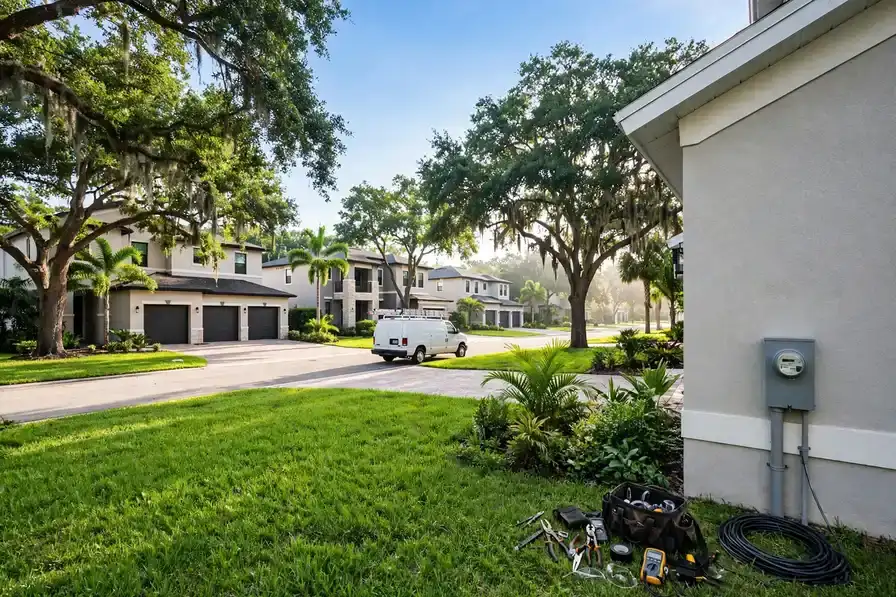
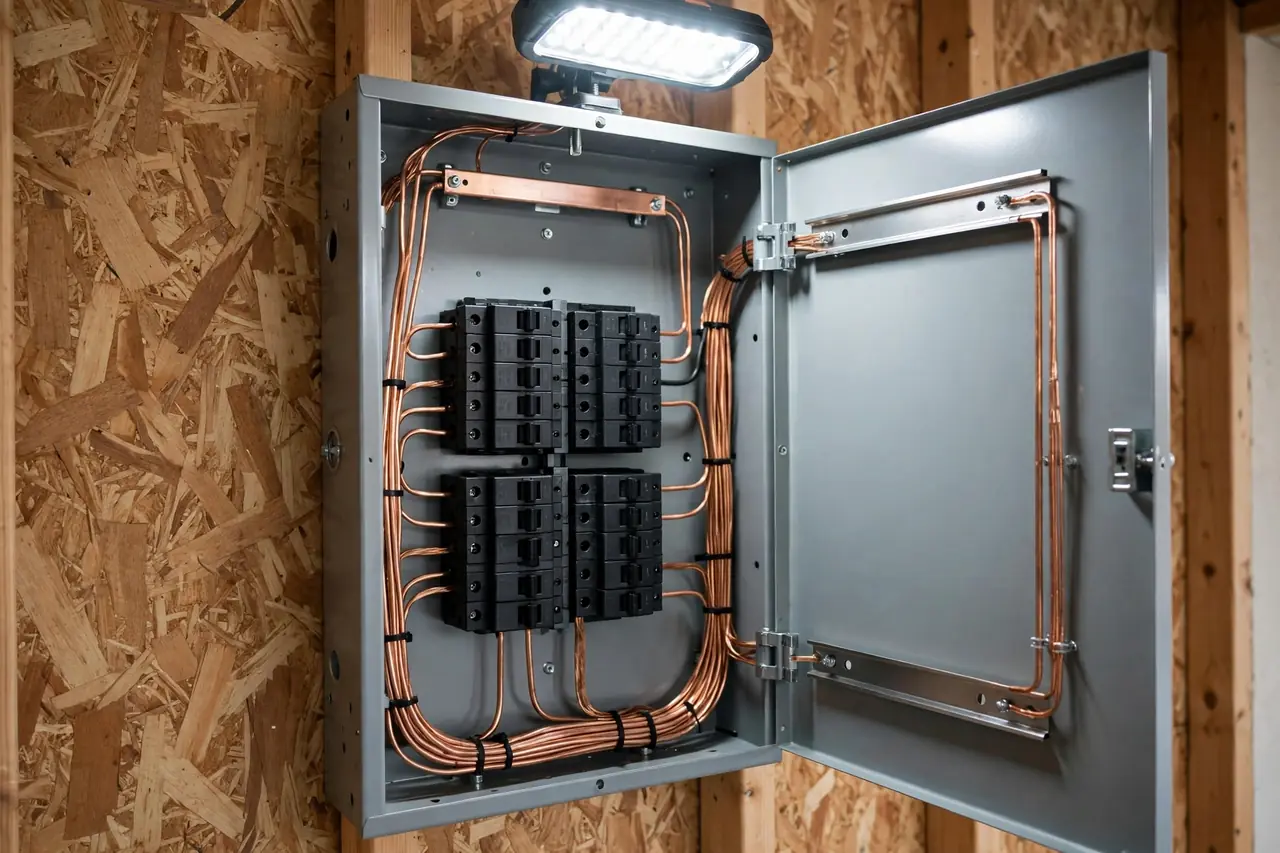
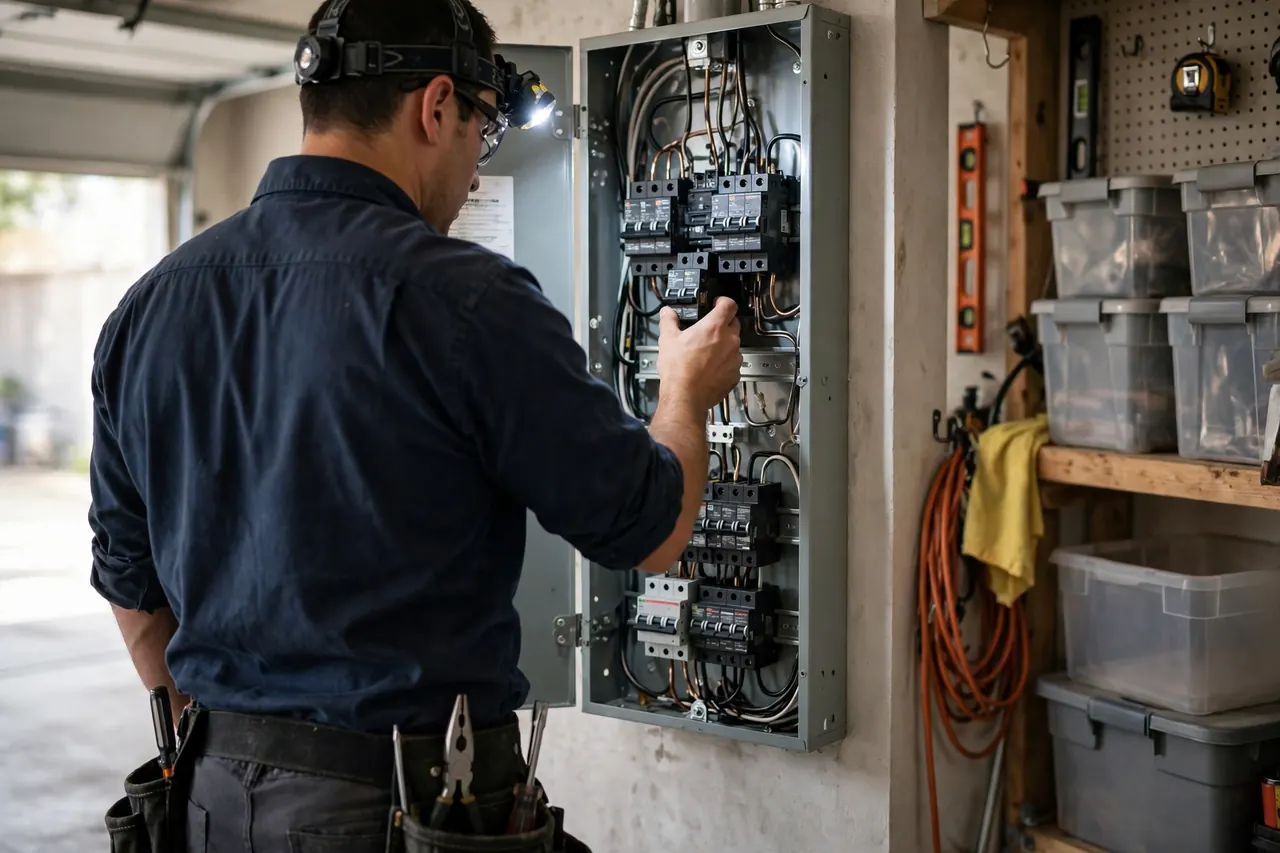
Lakeland, FL — electrical help across the metroLocal electricians serving Lakeland neighbourhoodsUpgrading a panel in a Lakeland home
Lakeland electrical work, in brief
The median Lakeland home was built in 1991; 31.9% of the stock predates 1980, and the pattern this metro's own data ranks first is overloaded circuits in lakeland. VoltReach USA is a referral service, not an electrical company: one call connects you with an independent local electrician serving your ZIP code.
The Lakeland housing stock, and what it means for wiring
Read Lakeland through its counties and the picture sharpens. Polk were not built in the same decades or for the same households, and their wiring carries those differences: an older core where 10.6% of the metro's homes predate 1960, growth corridors where the subdivisions arrived in waves, and edges still being built out. The metro-wide medians — a middle home built in 1991, 329,750 housing units in all — are the average of those local stories, and the sections below are organised by the patterns the combined record produces, from the oldest wiring generations to the newest failure modes.
Stand in one of Lakeland's older neighbourhoods and you are standing in its wiring's back catalogue. The homes there — part of the 105,190 built before 1980 across this metro — went up when a 60- or 100-amp panel was generous, a kitchen might have two circuits, and grounding was a rumour in half the rooms. Those budgets have now been spent many times over by modern loads. What it leaves behind is not universal failure but universal exposure: every panel, breaker and connection in those districts is operating past the horizon its makers planned for, in Polk County and beyond, and the failures arrive in the order the components tire.
The growth side of the metro tells the opposite story in the same language. Poinciana, Winter Haven and the subdivisions still filling in account for much of the 119,370 homes built since 2000 — modern panels, grounded circuits, AFCI protection in the bedrooms. Their electrical systems are not old; they are uniform, which creates its own calendar: everything installed in the same boom reaches each wear point in the same years, from the first detector replacements to the first panel-capacity conversations, while 3,929 cooling degree days of annual heat keep demand on the system high.
Over everything sits the weather, and here it is measured rather than described: NOAA's station at WINTER HAVEN GILBERT AP, FL US averages 74.6 degrees across the year, with 121.3 days reaching 90 or more and 1.3 nights at freezing or below. A panel feels that record as load that swings with the seasons; a circuit feels it on the single coldest night when every heater in the house runs at once; a service line feels it in the storm weeks. The problem ranking below is what those numbers, crossed with the housing profile, produce for Lakeland specifically.
The Lakeland electrical profile in numbers
Housing eras and climate, joined — the two datasets every section of this page is built from.
The distribution, in one breath: of every hundred Lakeland homes, 10.6 were standing before 1960, 21.3 went up in the two decades after, 31.9 in the two after that, and 36.2 have arrived since 2000. Percentages flatten the picture, so hold the counts beside them — 34,954 oldest-era homes, 119,370 newest — and the metro's electrical systems stop being an abstraction: that many panels, that many wiring generations, ageing in that order.
Growth defines Lakeland: the largest share of its housing was built from 2000 onward, 36.2 of the stock and 119,370 homes, lifting the median year to 1991. These homes generally arrived with 200 amp panels, grounded circuits throughout, modern protection and garages and layouts that anticipate vehicle charging in Lakeland, Poinciana and Winter Haven. The electrical questions in Lakeland, Florida are therefore about first-wave ageing rather than legacy systems: original devices, breakers and smart equipment installed in Polk at construction are now reaching replacement age together, and added loads continue to accumulate on otherwise sound systems. It also shifts everyday questions toward integration, how chargers, storage, controls and appliances share a capable panel without nuisance trips or overloaded individual circuits.
Housing from 1980 to 1999 is the second-largest presence in Lakeland, 105,190 homes spread through Lakeland, Poinciana and Winter Haven. Electrically these are transitional homes in a useful sense: copper wiring and breaker panels throughout, ground-fault protection beginning in wet areas, but capacities of 100 to 150 amps that modern loads press against. In Polk, this band often produces the most straightforward assessments in Lakeland, Florida, because the systems are coherent and documented by their era, with age and added demand, rather than obsolete methods, as the main considerations. Streets in Haines City built in this wave are a familiar sight during breaker and capacity assessments across the working week.
Precipitation and storms give Lakeland its third electrical load: exposure. The 46.12 recorded annually at WINTER HAVEN GILBERT AP, FL US arrives in events that test exterior fittings, bring lightning and surges, and interrupt power across Polk, sometimes for the 276,643 households least able to manage without it. In Lakeland, Winter Haven and Haines City, outage experience varies with service type and tree cover, but the underlying pattern is metro-wide. Combined with temperature extremes of 121.3 hot days and 1.3 freezing days, the climate profile of Lakeland, Florida asks a lot of grounding, protection and backup planning in Polk homes. Households feel the same reality as routine, in afternoon trips, cold-morning callouts and storm-season checks that recur with the calendar across the metro each year.
The method behind this profile is deliberately simple for Lakeland: rank the housing eras by their share of the stock, rank the climate loads by the WINTER HAVEN GILBERT AP, FL US record, and read the two together. Where the largest era and the heaviest load overlap in Lakeland, Winter Haven and Haines City, the characteristic electrical questions of Lakeland, Florida appear. That is why two metros with similar housing can feel different in practice, and why independent local electricians in Polk ground their assessments in both the build year of the home and the seasons it must endure.
Electrical services in Lakeland
Sequenced by this metro's own problem ranking, not by a national catalogue order.
Circuit Breaker Repair in Lakeland
Many Lakeland homes were built around 1991, long before today's appliance loads. When a breaker in Polk starts tripping under everyday use, VoltReach USA connects the homeowner with an independent local electrician who checks the panel, the load, and the wiring as one picture.
Seasonal load is the backdrop to many breaker calls in Lakeland, Florida. At WINTER HAVEN GILBERT AP, FL US, 121.3 hot days and 3,929 cooling degree days drive air conditioning that cycles breakers hard all summer, while 1.3 freezing days and 421 heating degree days bring auxiliary heat and space heaters onto circuits in winter. A breaker may hold in mild weather and trip only at the seasonal peak, which is useful diagnostic information. Homeowners across 276,643 households in Polk often notice exactly that pattern. Independent local electricians can use the timing a Lakeland household reports to focus testing on the loads and circuits most likely involved. Households in Winter Haven sometimes discover the culprit is a single appliance cycling on, rather than the breaker that reports its behaviour. A Lakeland home's electrical story, its 1991 median era, its panel, its grounding and its climate load, is individual, and independent local electricians serving Florida can read that story on site and explain the options it leaves open for the household.
Breaker trips in Lakeland often cluster at seasonal peaks recorded at WINTER HAVEN GILBERT AP, FL US: 121.3 hot days driving cooling load and 1.3 freezing days driving heating load, within 3,929 cooling and 421 heating degree days annually. That timing is diagnostic. Independent local electricians can use when a Lakeland household reports trips to focus testing on the circuits and loads most likely involved in Polk.
From Lakeland to Haines City, Lakeland homeowners ask about surge protection after losing electronics once. VoltReach USA connects you with an independent local electrician for an honest conversation about reduction, not immunity.
The modern load argument for surge protection in Lakeland grows stronger each year. A single home may now contain smart thermostats, network equipment, variable-speed heating and cooling controls, premium appliances, entertainment systems and vehicle charging electronics, representing a large combined value on circuits throughout the house. With 70.0 owner occupancy and 329,750 housing units, owners in Polk increasingly treat protection as part of stewardship of the home itself. Independent local electricians can inventory the sensitive loads in a Lakeland home, discuss layered protection honestly, and clarify what panel-level devices can and cannot do so expectations stay realistic. Owners in Poinciana who add a generator or vehicle charger later should mention their surge arrangement, because systems interact at the panel. Homeowners in Lakeland, Florida who notice Overloaded Circuits in Lakeland or surge exposure in Lakeland are encouraged to have the circuit checked rather than work around it, and independent local electricians can advise whether the issue is isolated or part of a wider pattern in the home.
Exposure in Lakeland combines storm weather and dense electronics: WINTER HAVEN GILBERT AP, FL US records 46.12 of annual precipitation, while 329,750 housing units now hold far more sensitive equipment than when most were built around 1991. Panel-level protection in Lakeland, Florida addresses surges entering through the service. Independent local electricians can check grounding in a Polk home, which determines how well any protection can perform.
In Lakeland, rewiring questions usually start room by room: a kitchen in Lakeland, a nursery in Poinciana, an office where grounded outlets matter. Independent local electricians can map the existing circuits and explain a sensible order of work. The findings are usually mapped circuit by circuit, so owners can see which rooms come first and which sound runs can stay in service longer.
The map of Lakeland is also a map of wiring age. Older districts near Lakeland hold the deepest stock of early housing, while growth near Poinciana, Winter Haven and Haines City added 119,370 homes since 2000 with contemporary wiring throughout. Between them, streets built in the 1960s, 1970s and 1980s fill 1 counties with their own mix. A homeowner comparing rewiring in Lakeland is really comparing eras, because access, wall construction and existing circuits differ sharply by neighbourhood and decade. Independent local electricians who work across Polk can explain those differences in practical terms and help owners in Florida plan around occupancy and renovation timing. The mix of plaster, drywall and later additions found near Lakeland means opening walls is planned carefully, room by room, in advance. Residents of Poinciana (71,665), Winter Haven (52,846) and Haines City share the same WINTER HAVEN GILBERT AP, FL US weather and the same broad housing eras, so a conversation with independent local electricians about a Lakeland home can usefully begin with when it was built and how it is loaded in peak season.
The Lakeland climate recorded at WINTER HAVEN GILBERT AP, FL US includes 1.3 days at or below freezing, 121.3 hot days and 46.12 of precipitation annually. Wiring in Lakeland attics and walls experiences those extremes every year, and insulation on older conductors ages accordingly. Independent local electricians can weigh exposure and age together when assessing rewiring priorities for a home in Polk.
Heavy rain, around 46.12 inches a year in the Lakeland area, makes sump pumps essential in many basements. A generator circuit for the pump in a home in Winter Haven can be the difference between a dry floor and a cleanup. Keeping the pump powered through a storm is often worth more than every other circuit combined for homes with basements below the local water table line.
A standby or portable generator plan in Lakeland begins with the age and layout of the homes it would support. Many houses built around 1991, including stock in Polk where 31.9 predates 1980, have panels, fuel arrangements and room layouts that shape where equipment can sit and what it can carry. Neighbourhoods in Lakeland, Poinciana and Winter Haven differ widely in lot size and panel location. Independent local electricians can assess a Lakeland home's essential circuits, panel configuration and placement options, then explain how a generator connection would be arranged for that property rather than in general terms that ignore its era and layout. Fuel type, storage and delivery access at a property in Haines City all enter the discussion alongside the electrical connection itself. The 421 heating degree days and 3,929 cooling degree days recorded for Lakeland mean its homes work hard in both directions, so independent local electricians will usually ask about seasonal behaviour before recommending how a job in Lakeland should be approached.
Housing age matters for generator placement in Lakeland: 105,190 homes built before 1980 and 105,190 built from 1980 to 1999 present varied panel locations and lot layouts across 40 ZIP codes. Independent local electricians can survey a Lakeland property in Polk, note panel configuration and clearances, and explain how transfer arrangements would fit that particular home rather than a generic layout.
In Lakeland, the distance from panel to garage and the panel's spare capacity shape every charging installation. Local electricians serving Lakeland and Poinciana can measure both and explain your options.
Tripping breakers and full panels are common in Lakeland homes built before 1980. A local electrician can check your service in Lakeland or Poinciana and explain whether repair or replacement fits.
Wet, damaged, or arcing wiring in Lakeland homes should never be handled casually. VoltReach USA connects homeowners with independent local electricians and shares the first safety steps to take.
Dark counters, glare, or switches in the wrong place in a Lakeland home are design problems with electrical solutions. Local electricians serving Lakeland and Poinciana can rework layout, fixtures, and dimming.
A fan is only as good as its mounting and sizing. Homeowners in Lakeland use VoltReach USA to reach independent local electricians who match fan size to the room in Lakeland, Poinciana, and across Polk.
In Lakeland, loose, warm, or crackling devices should be replaced, not tolerated. VoltReach USA connects you with an independent local electrician who can renew outlets and switches safely.
In Lakeland, every level and sleeping area needs working detectors. VoltReach USA connects homeowners with independent local electricians who install, interconnect, and test units across the home.
New equipment or a refit coming up in Lakeland, Florida? VoltReach USA refers businesses to independent local electricians who can plan dedicated circuits and lighting around the layout.
If this page's services were ranked by Lakeland's call patterns rather than listed in catalogue order, they would come out much as they do here — because the ranking behind them is data, not habit. Overloaded Circuits in Lakeland leads the metro's problem table and surge exposure in Lakeland follows, so the services answering them lead the list. The long tail of a metro's electrical life — device failures, lighting calls, the one circuit nobody can explain — fills in the diary around them, here as everywhere.
Electrical problems Lakeland homes actually get
Ranked for this metro alone, from its Census housing profile and NOAA climate record.
Overloaded Circuits in Lakeland
A circuit breaker protects the wiring in its circuit from carrying more current than it was sized for, and tripping is that protection working. When a breaker in a Lakeland home trips repeatedly, the useful question is why the load keeps crossing the limit, not how to stop the breaker from objecting. Fitting a larger breaker without changing the wiring would silence the warning while removing the protection, which is why electricians do not treat that as a repair. The real work is diagnostic: map what the circuit feeds, measure or calculate the combined draw, inspect the breaker and connections, and then correct the cause, whether that is redistributing loads, dedicating a circuit, or repairing a genuine fault.
If trips are new in a Lakeland home that previously coped, treat the change itself as the clue. Something altered: a new appliance, a heater moved rooms, a home office added, or a device beginning to fail and draw abnormally. Mention that timeline when you speak with an electrician, and mention whether trips happen instantly or after sustained use, and whether any outlet or switch feels warm. Warmth at devices, discoloration, or a breaker that will not reset are reasons to stop using the circuit and seek prompt help in Lakeland. A clear account of what changed turns a vague report of tripping into a short, focused diagnostic visit.
Season sharpens the pattern in Lakeland. During the hottest stretches, when the seasonal average reaches 74.6 and air conditioning runs for long hours, circuits and panels carry their heaviest sustained loads of the year. The same weeks bring guests, cooking and laundry peaks in many Lakeland homes. Breakers that stayed quiet all spring begin tripping in July, not because they weakened over winter but because the load finally crossed their limit and stayed there. Electricians serving Polk see this timing every year. A homeowner who notices trips clustering on the hottest afternoons has already gathered the most useful clue an electrician could ask for: when, and with what running.
What does installing whole home protection involve in a Lakeland house? An electrician assesses the panel — its type, available space, grounding condition, since a surge device depends on a sound grounding path to divert energy — and selects a device suited to the service. Installation connects the device at the panel with short, direct leads, because lead length affects how well it responds. The electrician then explains the device's indicator, which shows whether protection remains active, since these devices sacrifice themselves gradually or in a single large event and need replacement when their capacity is spent. That maintenance point matters in Lakeland: a device whose light has gone out is a panel ornament, not protection.
If electronics have failed around electrical events in a Lakeland home, gather the timeline before speaking with an electrician. Note what failed, roughly when, and what the weather or grid was doing at the time — storm overhead in Haines City, outage and restoration, or a calm day with no event you noticed. That record helps distinguish a surge pattern from ordinary appliance ageing, and honest electricians in Lakeland will say when the record points away from surges. Either answer is useful. A surge explanation leads to protection work. An ageing explanation leads to appliance planning. What a household should avoid is replacing board after board in Lakeland without ever asking whether an exposure sits behind the sequence.
Newer building and renovation patterns in Lakeland complete the picture. Home offices in Lakeland, workshops, electric vehicle chargers and smart home systems concentrate valuable electronics in Lakeland homes, often in the 105,190 homes built between 1980 and 1999 that form so much of the local stock. Many of these homes were built before whole home surge devices became a common part of a panel. The gap is not a fault; it is an era difference, like insulation standards. Closing it is a defined piece of electrical work — a surge protective device installed at the panel by an electrician, sized and connected correctly — that brings an older service up to the exposure its contents now face.
Watch for
Electronics failing after thunderstorms
HVAC control board replaced following an outage
No surge device present at the panel
Surge device indicator showing protection spent
Appliance displays glitching after power flickers
Home office or entertainment equipment unprotected
Buying and selling often brings this topic forward in Lakeland, and it helps to keep it in proportion. A home inspection may note aluminum branch wiring in a 1960s or 1970s house in Winter Haven or Bartow, and the note can sound more alarming than the underlying finding. The useful next step for either side is documentation: has the wiring been assessed, were connections remediated with listed methods, and is there a record of that work? VoltReach USA connects Lakeland homeowners with independent local electricians who can inspect and explain, giving a transaction a factual basis. Clear documentation serves the current owner as much as the next one, whatever the timing of any sale.
If you are planning work in a Lakeland home from this era, sequence matters. Have the wiring identified before walls are opened for other trades, before new devices are chosen, and before a remodel budget is fixed around assumptions. Early knowledge lets a homeowner in Lakeland choose devices rated appropriately, plan any remediation alongside the renovation access, and avoid reopening finished walls later. Independent local electricians can usually identify wiring type quickly during an assessment, and that early clarity is inexpensive in effort compared with the disruption of discovering mixed or deteriorated connections halfway through a project in Lakeland.
The story of aluminum wiring in Lakeland is a story about connections more than cable. The wire runs hidden in walls in Haines City and Bartow are not the usual focus. The points where aluminum meets a device — an outlet terminal, a switch screw, a wire connector in a box — are where time changes things. Aluminum expands and contracts with heat, forms an oxide surface, and can loosen at terminations that were not made for it. After decades of daily heating and cooling cycles, having those connection points assessed in a 1960s or 1970s Lakeland home is a measured, practical step.
Surges at restoration are the quiet companion of outages in Lakeland, and they link this pattern to protection choices. When supply returns after a fault, voltage can overshoot briefly, and switching elsewhere on the network adds smaller surges over time. Modern Lakeland homes concentrate the equipment most sensitive to those events: HVAC control boards, appliance electronics, computers and entertainment systems. Point of use protectors help individual devices, while a whole home device at the panel addresses surges entering through the service. After a stormy season in Florida, many homeowners use the experience to assessment that layered protection with an electrician, turning a rough week into a concrete improvement before the next event.
Preparation in Lakeland can be modest and still effective. Know where the main disconnect is and how to use it. Keep the panel area accessible and dry. Note which circuits matter most during an outage, so a generator conversation starts from a clear list. Keep portable generators stored with their instructions, and never improvise their connection. After each significant event, walk the house once power is stable and note anything electrical that behaves differently in Lakeland or elsewhere in the home. Those notes, shared with an electrician, convert a storm from a story into a checklist, and checklists are how storm prone households in Lakeland steadily harden their systems.
The damage pattern in Lakeland often begins after the storm, not during it. Wind and water do their visible work first — branches on lines, water finding its way into an exterior panel or a basement in Haines City — but the electrical consequences surface at restoration, when a surge travels through the system as supply returns, and in the following days, when damp connections corrode and breakers that took in moisture begin to misbehave. Homeowners in Lakeland who understand that timeline watch their systems more carefully in the week after an event, and mention the storm history promptly when an electrician visits for what looks like an unrelated fault.
Recovery has its own electrical discipline in Lakeland once a storm has passed. As power returns street by street across Polk, watch the system rather than simply welcoming the lights: repeated tripping in the days after restoration, a burning smell or buzzing at the panel, outlets in areas where water stood, and electronics that failed at the moment supply returned all merit an electrician's assessment. Water that reached a panel or devices in a Lakeland home leaves corrosion that progresses quietly, so noting where water got to — and saying so when you call — matters more than how dry things look now. Hurricane season in Florida returns every year; a documented post storm check makes each year's recovery shorter than the last.
After a major storm passes Lakeland, the electrical risks change rather than end. Restoration across Polk can bring surges, partially restored service can run equipment at abnormal voltage, and moisture that entered panels or exterior fittings in Lakeland and Poinciana may cause faults days later. The 46.12 recorded at WINTER HAVEN GILBERT AP, FL US in a single event can be a large share of the annual total. Homeowners in Lakeland, Florida should treat odd smells, discoloured outlets or new tripping after a storm as reasons for inspection. Independent local electricians can carry out those post-storm checks in Polk methodically.
A closer look: overloaded circuits in lakeland in Lakeland
Sustained load is the concept that separates a nuisance from a risk in Lakeland, and it is worth a closer look. Circuits are rated with the expectation that heavy loads are intermittent; a load that runs for hours, like air conditioning through a Lakeland heat spell or a heater on a cold night, heats conductors, terminations and the breaker itself continuously. Connections that are slightly loose or aged show that heat first, which is why an electrician inspecting a repeatedly tripping circuit also looks for discoloration and checks termination tightness rather than simply confirming the trip threshold. The trip, in other words, can be both a load signal and an invitation to inspect. A Lakeland home where trips follow sustained loads deserves both readings: the arithmetic of what is plugged in, and the physical condition of the path that carries it, from breaker to the furthest receptacle in Winter Haven or Haines City.
Why here and not everywhere: Lakeland pairs 105,190 pre-1980 homes with 121.3 days a year at 90 degrees or more and 1.3 nights below freezing. Every metro pairs its housing with its weather somehow; this particular pairing is what puts the pattern where it sits on this page's list, ahead of problems that dominate metros built in other decades, under other skies.
On a first visit for this pattern, a local electrician's checks run in a practised order:
Map every outlet and light on the problem circuit
List appliance combinations running at trip times
Inspect breaker condition and termination tightness
Check devices for heat, wear or discoloration
Distinguish overload from short or fault trips
Assess panel capacity for an added circuit
From problem to fixed, in Lakeland
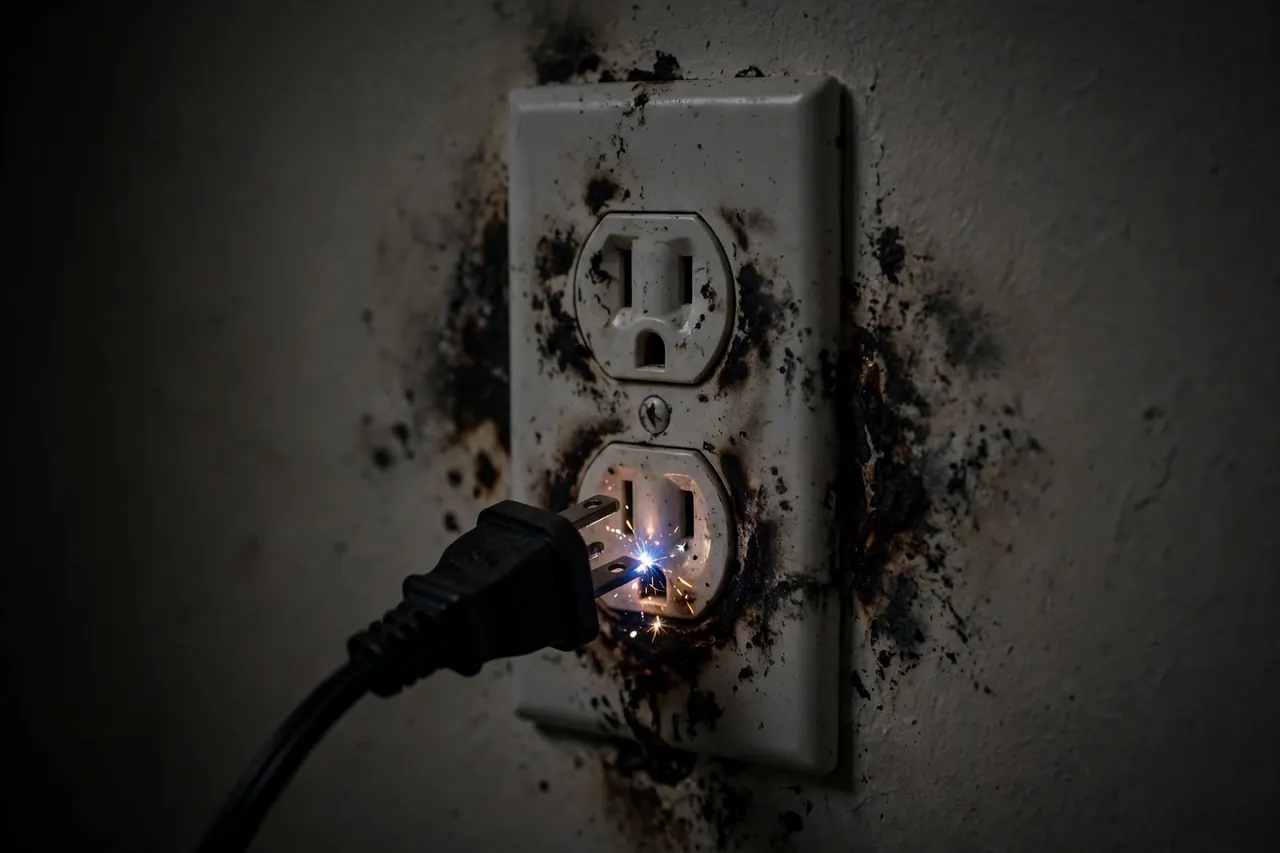
PROBLEMAn electrical problem inside a Lakeland home
➔
SOLUTIONThe same system in Lakeland after professional repair
Areas covered in the Lakeland metro
Lakeland
Population 117,030
Poinciana
Population 71,665
Winter Haven
Population 52,846
Haines City
Population 31,156
Bartow
Population 19,801
Auburndale
Population 17,438
Lake Wales
Population 16,365
Highland City
Population 12,732
Medulla
Population 11,712
Lakeland Highlands
Population 11,669
Davenport
Population 11,660
Fuller Heights
Population 10,697
Also in the Lakeland metro: Cypress Gardens (population 10,013), Loughman (population 7,535).
Beyond Lakeland itself, the metro takes in Poinciana (71,665 residents), Winter Haven (52,846) and the rest of the communities in the grid above — each wired in its own building era, which is why two streets in the same metro can need entirely different electrical conversations. The ZIP list below is the full coverage footprint: if your code is on it, this page was written about your housing stock.
Beyond the largest communities sit Haines City (31,156), Bartow (19,801), Auburndale (17,438), Lake Wales (16,365), Highland City (12,732) — smaller places across Polk, covered on the same terms. Their housing tends to be older on average than the big suburbs', and their calls follow the older patterns on this page. One routing covers them all: find your ZIP code below and the rest is a phone call.
Lakeland (117,030 residents) anchors the metro, and Poinciana (71,665) is its second centre of gravity. Between them they hold the bulk of the 276,643 households — and, not coincidentally, the bulk of every housing era this page discusses, from the pre-1960 core to the newest subdivisions. Winter Haven (52,846) and the communities beyond it repeat the same eras at smaller scale.
The metro answers to 1 county governments (Polk), a patchwork that matters at permit time rather than at the panel. Polk County carries the centre; the others carry the growth rings and the older outlying towns. An electrician routed through this page works inside that patchwork daily — the current does not care about the boundaries, but the job's paperwork does.
This page ends at the metro boundary, but the region does not: Orlando, FL, Tampa, FL and The Villages, FL continue the coverage in their own directions, each with a profile built from its own Census and NOAA figures. If your home sits near the line between metros, go by your ZIP code — it places you in the dataset that describes your housing.
Set Lakeland among its neighbours and the contrasts sharpen the profile: Orlando, FL — metro population 2,957,672, median build year 1994 — sits 44 miles away; Tampa, FL (3,418,895, median 1985) 54 miles; The Villages, FL (157,772, median 2005) 57 miles. Three different housing stocks under three nearby skies, which is why each keeps its own page and its own problem ranking rather than borrowing this one.
The stock has a shape as well as a size. Owners hold 70.0% of it and renters 30.0%, a split that decides who notices a flicker first and who arranges the repair. The generations split 0.9-to-one in favour of the pre-1980 homes. And the map divides into 14 named communities across Polk, each carrying its era's share of the 329,750 housing units the Census counts here.
Lakeland by the derived numbers — median home age 35 years · owners in 193,650 homes, renters in 82,993 · each covered ZIP code carrying about 874 pre-1960 homes · a heating-to-cooling degree-day ratio of 0.11 · 1,171 mm average annual rainfall.
Lakeland electrical questions
Is my neighbourhood in Lakeland inside the VoltReach USA coverage area?
Coverage on this page is defined in a plain, checkable way: if your ZIP code appears in the 40 codes listed for Lakeland, Florida, and your home sits inside Polk, you are inside the area this page was built for. VoltReach USA is a referral service, so coverage means the page can connect you with an independent local electrician who works in that territory, not that VoltReach itself sends a crew. Start by matching your code against the list, then check your county against Polk and the neighbouring counties named above. If both line up, use the contact route on this page and describe your panel, circuit or wiring concern in your own words. A second way to read the same boundary is through the communities it contains: Lakeland with 117,030 residents, then Poinciana, Winter Haven, Haines City and Bartow, together account for much of the 760,961 population of the metro, and a home inside those communities and inside a listed code sits squarely within the territory this Lakeland page was researched and written to serve. Compressed further, coverage here rests on three countable things: the code run beginning 33801, 33803, 33805, 33809, the 40 codes in total across Polk, and a housing base of 329,750 homes whose era profile, centred on the 1990s, is the reason this page exists for Lakeland at all. Stated as the communities those codes contain: the community ledger reads Lakeland (117,030 residents), Poinciana (71,665), Winter Haven (52,846), Haines City (31,156) and Bartow (19,801), out of 760,961 residents metro-wide. Read it against a median build year of 1991 and a 31.9% share of homes from before 1980. It is written for a metro whose largest places are Lakeland (117,030 residents), Poinciana (71,665) and Winter Haven (52,846). The housing ledger behind it counts 34,954 homes from before 1960 and 119,370 built since 2000 across the metro. All of it describes the Lakeland–Winter Haven metro as the Census defines it - 760,961 residents in 329,750 housing units. The weather record behind it is WINTER HAVEN GILBERT AP, FL US's: 421 heating degree-days against 3,929 cooling degree-days in an average year.
Does the age of my Lakeland home change how closely I should watch its electrics?
If your Lakeland home was built before 1980, put it in the close-watch group and keep it there. That group covers 105,190 homes locally, including 34,954 built before 1960. Those homes have commonly gained demand in layers: an added room here, a heavier appliance there, extra outlets worked into circuits that were modest at the start. The panel may look tidy while sitting near the edge of what its circuits can comfortably carry. Signs worth noting include breakers that need resetting more than rarely, lights that dip when a motor starts, outlets that have stopped working, and any burning smell near a switch or outlet. Noting the pattern, and when it happens, helps an electrician judge the system far faster. Across the wider metro the same pattern repeats from Lakeland through Poinciana and Winter Haven into the outer communities: the closer a neighbourhood sits to the historic core of Lakeland, the older its era profile tends to be, with 34,954 homes built before 1960 and 70,237 from 1960 to 1979 shaping the risk map far more than any single street, which is why this page reads age by area rather than treating Lakeland as one uniform stock. The ownership figures add a practical edge to the watch list, because with 70.0% of 276,643 households owning their homes in Lakeland, most of the older stock is looked after by the people living in it, and the panel and wiring decisions for 105,190 pre-1980 homes rest with those households directly, which makes an honest yearly watch a normal part of owning an older Lakeland home. In ledger form the priority is stark: 10.6% before 1960 and 21.3% from 1960 to 1979, set against a WINTER HAVEN GILBERT AP, FL US record of 1.3 freezing days and 121.3 hot days cycling those old circuits yearly, which is the whole argument for watching the oldest third of Lakeland housing closest. For the watch list stated as codes: the codes run 33801, 33803, 33805, 33809 and 33810 among the 40 on the list, spread over Polk. All of it describes the Lakeland–Winter Haven metro as the Census defines it - 760,961 residents in 329,750 housing units. Read it against a median build year of 1991 and a 31.9% share of homes from before 1980. The housing ledger behind it counts 34,954 homes from before 1960 and 119,370 built since 2000 across the metro. The weather record behind it is WINTER HAVEN GILBERT AP, FL US's: 421 heating degree-days against 3,929 cooling degree-days in an average year. Run the same ranking for nearby North Port–Sarasota and its leading pattern is overloaded circuits - a different order from Lakeland's, which is why this site keeps a separate page for every metro.
What is the most common electrical problem in Lakeland homes?
Ask what fails most in Lakeland and the data points to Overloaded Circuits in Lakeland, followed by surge exposure in Lakeland. The method behind that answer is set out on this page: housing-age figures from the Census, weather normals from the local station, and the known weak points of each wiring generation present in the stock. Where older homes dominate, panel capacity and circuit condition tend to lead. Where growth is newer, the order can shift toward wear in heavily used circuits and outdoor fittings. Your home may not follow the city pattern at all, and that is normal. Rankings describe a metro of 329,750 homes. They are a map of where attention usually pays off first, and a prompt to compare your own symptoms against the pattern. The third name on the podium, aluminum wiring in Lakeland homes, keeps the top two honest, because it shows the ranking is a genuine ordering rather than a single headline: each step down the podium corresponds to causes that are present in Lakeland but less widespread, whether measured by era share, by seasonal load at WINTER HAVEN GILBERT AP, FL US, or by the share of homes whose panel and circuit layout exposes them to that particular failure pattern. The densest summary of why Overloaded Circuits in Lakeland leads in Lakeland fits in one breath: 105,190 homes built before 1980, a median year of 1991, 46.12 of precipitation and a population of 760,961 whose daily demand lands on panels and wiring installed, in large part, for a lighter electrical age. With the leading problem stated by community: the community ledger reads Lakeland (117,030 residents), Poinciana (71,665), Winter Haven (52,846), Haines City (31,156) and Bartow (19,801), out of 760,961 residents metro-wide. It is written for a metro whose largest places are Lakeland (117,030 residents), Poinciana (71,665) and Winter Haven (52,846). Read it against a median build year of 1991 and a 31.9% share of homes from before 1980. The coverage behind this answer spans ZIP codes 33801 through 33812 - the ZIP list published on this page. The housing ledger behind it counts 34,954 homes from before 1960 and 119,370 built since 2000 across the metro. All of it describes the Lakeland–Winter Haven metro as the Census defines it - 760,961 residents in 329,750 housing units.
What does the Lakeland climate do to panels, circuits and wiring?
Think of Lakeland weather as a load test that repeats every year. The station record at WINTER HAVEN GILBERT AP, FL US, with 46.12 of precipitation, an average of 74.6, and the seasonal spread between 421 heating degree days and 3,929 cooling degree days, describes a test your panel and circuits sit annually whether you plan it or not. Systems with capacity to spare pass quietly. Systems already near their limits announce themselves during the test: breakers trip on the hottest afternoons, circuits complain on the coldest nights, and outdoor fittings fail after wet spells. That timing is useful information. If a fault keeps the same season as the weather that triggers it, tell an electrician exactly that. Seasonal timing is one of the clearest clues in household electrical diagnosis. Read the WINTER HAVEN GILBERT AP, FL US record as a metro average rather than a street forecast, because conditions in Lakeland vary between the built-up centre around Lakeland, the communities of Poinciana and Winter Haven, and the fringe areas near the county lines of Polk: elevation, tree cover and exposure differ, yet every part shares the same seasonal load swing, and it is that shared swing, acting on different ages of wiring, that produces such different electrical outcomes within one metro. Precipitation completes the local picture alongside temperature: 46.12 in a typical year at WINTER HAVEN GILBERT AP, FL US means outdoor outlets, garage circuits and exterior fittings in Lakeland are wetted regularly across the seasons, and in a stock of 329,750 homes that steady wetting, working on covers and seals of very different ages, quietly decides which outdoor circuits stay sound and which begin to fail after storms. Set the climate beside the codes and the picture tightens: from 33801 through 33809 and beyond, homes in Lakeland, population 117,030, and homes in the smallest listed communities alike sit under the same 421 heating and 3,929 cooling degree-day totals, differing only in the age of the systems carrying that shared load. With the weather load stated against the codes: the codes run 33801, 33803, 33805, 33809 and 33810 among the 40 on the list, spread over Polk. The housing ledger behind it counts 34,954 homes from before 1960 and 119,370 built since 2000 across the metro. All of it describes the Lakeland–Winter Haven metro as the Census defines it - 760,961 residents in 329,750 housing units. The coverage behind this answer spans ZIP codes 33801 through 33812 - the ZIP list published on this page. It is written for a metro whose largest places are Lakeland (117,030 residents), Poinciana (71,665) and Winter Haven (52,846). The footprint takes in Polk County - 1 covered county in all, each with its own page on this site.
What are the first safe steps when an outlet sparks or smells of burning in the Lakeland metro?
Treat a burning smell or sparks as a stop signal, not a puzzle to solve. Stop using the outlet, keep hands away from it, and move anything plugged into it only if the plug and outlet are cool, dry and undamaged to the touch. Keep children and visitors clear of the room if the smell is strong. Switching the circuit off at the breaker is a sensible step only when the path to the panel is clear, the floor is dry, and the panel shows no heat, buzzing, scorching or moisture. If any of those signs are present, leave the panel alone. Flames, spreading smoke, a fallen service line or a strong smell filling the home all mean the same thing: get out and call emergency services, then the utility for anything involving lines outside. An electrician visit comes after safety, arranged once the scene is calm. If this happens in your Lakeland home, remember that help is organised locally: the coverage area on this page spans 40 ZIP codes across Polk, from Lakeland to Bartow, and the electrician you are connected with works in that same territory, so give your ZIP code and your community name when you make contact after the immediate danger has passed, because that detail routes your enquiry to the right part of the metro without delay. Once the immediate danger has passed, the details you pass on help more than you might expect: your ZIP code within the 40 listed for Lakeland, the room involved, whether water was anywhere nearby, and whether the breaker stayed off, together let the independent electrician arrive understanding the circuit's story, and in a metro of 276,643 households that clarity is what separates a focused first visit from a second one. The numbers worth having ready after such an incident in Lakeland are few and specific: your code among 33801 to 33812, your community, Lakeland at 117,030 residents being the largest, and the circuit's behaviour before the smell or sparks, because those details carry more diagnostic weight than any general description of the metro. After an incident, stated for the record by era count: the era ledger reads 34,954 homes before 1960, 70,237 from 1960-1979, 105,190 from 1980-1999 and 119,370 since 2000 — 329,750 units, 276,643 households, 70.0% of them owner-occupied. The Census identity of this metro, Lakeland–Winter Haven with 760,961 residents, 70.0% owner-occupied and a median build year of 1991, explains why such incidents cluster in older circuits here compared with Orlando, FL at 44, Tampa, FL at 54 and The Villages, FL at 57: the podium faults Overloaded Circuits in Lakeland, surge exposure in Lakeland and aluminum wiring in Lakeland homes all grow from the same ageing stock that makes conservative first steps so important locally. The code walk also helps the electrician who follows up in Lakeland: naming where in the sequence 33801, 33803, 33805, 33809, 33810, 33811, 33812 your home falls, together with the circuit involved and whether the breaker was left off, places the incident on the metro map at once, shortening the first conversation and letting the visit begin with the faulty circuit rather than with geography. Run the same ranking for nearby Tampa and its leading pattern is overloaded circuits - a different order from Lakeland's, which is why this site keeps a separate page for every metro. The coverage behind this answer spans ZIP codes 33801 through 33812 - the ZIP list published on this page. It is written for a metro whose largest places are Lakeland (117,030 residents), Poinciana (71,665) and Winter Haven (52,846). The weather record behind it is WINTER HAVEN GILBERT AP, FL US's: 421 heating degree-days against 3,929 cooling degree-days in an average year. Read it against a median build year of 1991 and a 31.9% share of homes from before 1980.
How do I know if my Lakeland home needs rewiring instead of a repair?
The dividing line is pattern against incident. A single fault with a clear local cause, a damaged outlet, a breaker at the end of its life, one circuit overloaded by one new appliance, usually belongs in repair territory. Rewiring enters the conversation when faults repeat across rooms served by the same generation of wiring, when insulation is crumbling wherever it is inspected, or when the wiring type itself, such as older aluminum branch wiring or surviving knob-and-tube runs, is the underlying issue rather than any single fitting. In Lakeland, where 31.9% of homes predate 1980, that pattern question arises often. No page can settle it for your home. An electrician settles it by inspecting several points in the system and judging whether the faults share one root. The rewiring question lands differently across Lakeland depending on which ring of the metro a home occupies: the pre-1960 core around Lakeland and the older streets of Polk produce the pattern cases most often, the 1960 to 1979 suburbs through Poinciana and Winter Haven produce the material cases, and the newer ground toward Haines City and Bartow produces mostly isolated repairs, a geography written by the 105,190 homes built before 1980 across 40 codes. Ownership sharpens the decision in practice, since 70.0% of Lakeland homes are owner-occupied and the household weighing repair against renewal usually owns the consequences either way: a repair that merely relocates a pattern fault will be paid for again in another room, while a renewal scoped to the faulty wiring generation settles the pattern, and that arithmetic, applied honestly by an inspecting electrician, is how most rewiring decisions in this metro are actually reached. The tightest statement of the pattern test uses local figures only: where faults repeat across circuits in the 10.6% pre-1960 stock or the 21.3% stock from 1960 to 1979, under a WINTER HAVEN GILBERT AP, FL US load record of 421 heating degree days, the material is implicated; where they do not repeat, it usually is not. On renewal, stated against the era count in question: the era ledger reads 34,954 homes before 1960, 70,237 from 1960-1979, 105,190 from 1980-1999 and 119,370 since 2000 — 329,750 units, 276,643 households, 70.0% of them owner-occupied. Run the same ranking for nearby North Port–Sarasota and its leading pattern is overloaded circuits - a different order from Lakeland's, which is why this site keeps a separate page for every metro. All of it describes the Lakeland–Winter Haven metro as the Census defines it - 760,961 residents in 329,750 housing units. Read it against a median build year of 1991 and a 31.9% share of homes from before 1980. The coverage behind this answer spans ZIP codes 33801 through 33812 - the ZIP list published on this page. The housing ledger behind it counts 34,954 homes from before 1960 and 119,370 built since 2000 across the metro. The local starting point is the dominant era - post-2000 homes are 36.2% of the stock here - so the findings above are read against that generation's panels and circuits first.
Is VoltReach USA the company that does the work in the Lakeland metro?
No company from this website will arrive at your door, because VoltReach USA is not a company that does electrical work. It is a referral service with a research library attached. The library part is this page and its sister pages: era-by-era housing analysis for Lakeland, climate context from WINTER HAVEN GILBERT AP, FL US, and plain-language guides to faults and checks. The referral part is a routing step: your enquiry goes to an independent electrician local to Lakeland, who operates separately from VoltReach USA. Any conversation about your home, any visit, any findings and any work happen between you and that electrician. If that distinction ever feels unclear during the process, return to this answer. VoltReach USA publishes and connects. The independent electrician attends and works. Those are the roles, without embellishment. Nothing about the model changes at the county line, which matters in a metro drawn as Polk with Polk at its centre: the research on this page covers the whole of that territory, the referral routes within the whole of it, and the work itself is done within it by independent electricians local to their part of Lakeland, so a reader in Lakeland and a reader in Bartow are using the same honest arrangement, described in the same words, with the same limits. A useful test of the model is to notice what this page never offers: it offers no arrival window of its own, no crew, no work carried out by the publisher, because VoltReach USA has none of those things to offer in Lakeland or anywhere else, and a referral service that is clear about that absence, while still doing the research thoroughly across Polk, is giving a homeowner exactly the two things it honestly can, evidence and a connection. Count the roles by their numbers and the distinction stays plain: VoltReach USA's side of Lakeland is counted in pages, codes and datasets, 40 codes and 329,750 homes researched, while the electrician's side is counted in visits, circuits tested and panels opened, and no figure from the first list ever appears on the second side of the ledger. On who does the work, stated by coverage codes: the codes run 33801, 33803, 33805, 33809 and 33810 among the 40 on the list, spread over Polk. Read it against a median build year of 1991 and a 31.9% share of homes from before 1980. The weather record behind it is WINTER HAVEN GILBERT AP, FL US's: 421 heating degree-days against 3,929 cooling degree-days in an average year. Run the same ranking for nearby North Port–Sarasota and its leading pattern is overloaded circuits - a different order from Lakeland's, which is why this site keeps a separate page for every metro. The housing ledger behind it counts 34,954 homes from before 1960 and 119,370 built since 2000 across the metro. The footprint takes in Polk County - 1 covered county in all, each with its own page on this site.
What belongs on a yearly electrical check list for a Lakeland home?
Once a year, work through the same short circuit of your Lakeland home. Start with protection: test every GFCI outlet using its own test and reset buttons, and note any that fail to trip or fail to reset, because a device that does not trip is not protecting anyone. Move to detectors: test each smoke and carbon monoxide detector, and check the date printed on it. Then the panel, from the outside only: look for discolouration, listen for buzzing, notice any breaker that feels warm compared with its neighbours, and exercise each breaker off and on. Finish outdoors: confirm exterior outlets have intact covers and test any outdoor GFCI. Everything on that list is observation and button-pressing, which is exactly where homeowner checks should stop. Panel internals, wiring condition and repeated breaker trips belong to an electrician. Carry that yearly walk through the whole geography of your own home the way this page covers the metro, from the centre to the edges: homes in the older parts of Lakeland, around Lakeland and the early streets of Polk, earn extra attention on panel condition and outlet warmth, while homes in Haines City, Bartow and the newer subdivisions across Polk earn the same detector, GFCI and outdoor-cover discipline, because protection checks matter in every one of the 40 codes equally. The yearly round earns its keep in proportion to the stock it serves: across 329,750 homes in Lakeland, with 105,190 built before 1960 alone, even a short list of button tests and visual checks, repeated annually by 276,643 households, surfaces failed protection and early heat signs at a scale no inspection programme could match, which is why the modest homeowner list on this page is treated as a serious layer of the metro's electrical safety. Densest form: a stock profiled at 31.9% pre-1980, a station record of 1.3 freezing days and 121.3 hot days at WINTER HAVEN GILBERT AP, FL US, and 276,643 households each holding a short annual list of button tests and visual checks together amount to the metro's widest electrical safety net, provided the findings are handed onward. For the yearly round, stated by the housing it covers: the era ledger reads 34,954 homes before 1960, 70,237 from 1960-1979, 105,190 from 1980-1999 and 119,370 since 2000 — 329,750 units, 276,643 households, 70.0% of them owner-occupied. All of it describes the Lakeland–Winter Haven metro as the Census defines it - 760,961 residents in 329,750 housing units. The housing ledger behind it counts 34,954 homes from before 1960 and 119,370 built since 2000 across the metro. Run the same ranking for nearby Palm Bay–Melbourne and its leading pattern is overloaded circuits - a different order from Lakeland's, which is why this site keeps a separate page for every metro. Read it against a median build year of 1991 and a 31.9% share of homes from before 1980. It is written for a metro whose largest places are Lakeland (117,030 residents), Poinciana (71,665) and Winter Haven (52,846). In Lakeland the post-2000 generation dominates (36.2% of homes), which is why this page's version of the check leans toward that era's failure modes before the newer ones.
How did VoltReach USA rank the electrical problems for Lakeland?
The ranking was built from public data about Lakeland itself, scored the same way for every metro on this site. The housing half comes from the Census American Community Survey: how many homes fall into each build era, which sets how much of the stock carries each generation of wiring and panel design. The climate half comes from NOAA normals for WINTER HAVEN GILBERT AP, FL US: heating and cooling degree days, temperature and precipitation, which set how hard those systems work across a year. Each known problem is then scored against the eras and loads actually present. A fault tied to pre-1960 wiring scores heavily where pre-1960 homes are numerous and barely registers where they are rare. That is why rankings differ between cities even though the method does not. The method is uniform; the inputs are local, and the local inputs decide the order. Because the inputs are metro-wide, the ranking describes Lakeland as a place rather than any single district within it: era shares spanning 34,954 pre-1960 homes to 119,370 built since 2000, read alongside the WINTER HAVEN GILBERT AP, FL US climate record, produce one ordering for the whole territory of Polk, and local variation then does the rest, since a district dominated by one era will feel its era's problems more strongly than the metro ordering alone suggests to a reader in Lakeland or Bartow. Readers can test the ranking against their own knowledge of Lakeland in one specific way: if the podium, Overloaded Circuits in Lakeland, surge exposure in Lakeland and aluminum wiring in Lakeland homes, matches the faults neighbours in similar-era homes describe, the method is showing its local grounding, and where a street's experience diverges, the divergence usually traces to that street's era or exposure differing from the metro profile of 1991 median build year that the scoring started from. Strip the method to its tokens and it remains local: 33801, 33803, 33805, 33809 for place, 1991 for the median home, 10.6%, 21.3% and 31.9% for the era shape, and 74.6 with 46.12 for the climate, a set of figures no other metro on this site shares in exactly this combination. For the method, stated through its code geography: the codes run 33801, 33803, 33805, 33809 and 33810 among the 40 on the list, spread over Polk. The identity line behind this metro's ranking, Lakeland–Winter Haven, 760,961 residents, 70.0% owner-occupied, median build year 1991, is what separates its ordering from those of Orlando, FL at 44, Tampa, FL at 54 and The Villages, FL at 57: change the era shape or the ownership shape and the scores move, so the podium of Overloaded Circuits in Lakeland, surge exposure in Lakeland and aluminum wiring in Lakeland homes is a product of this metro's counted character. Walk the method by code and its local grounding shows street by street in Lakeland: the scoring that produced this ranking was applied to homes behind 33801, 33803, 33805, 33809, 33810, 33811 and 33812 alike, using the same era and climate inputs throughout, so no district in the list was favoured in the arithmetic and no district was left out of the evidence the ordering rests on. The footprint takes in Polk County - 1 covered county in all, each with its own page on this site. It is written for a metro whose largest places are Lakeland (117,030 residents), Poinciana (71,665) and Winter Haven (52,846). Read it against a median build year of 1991 and a 31.9% share of homes from before 1980. The coverage behind this answer spans ZIP codes 33801 through 33812 - the ZIP list published on this page. Run the same ranking for nearby Tampa and its leading pattern is overloaded circuits - a different order from Lakeland's, which is why this site keeps a separate page for every metro.
What are the electrical systems like in Lakeland's oldest homes?
The oldest homes in Lakeland cluster where the city began, and their electrical systems tell the story of demand growing faster than design. The pre-1960 core, 34,954 homes metro-wide, often began with few circuits, small panels and wiring methods of their day, sometimes including knob-and-tube runs in the oldest survivors and early cable in later ones. Around that core sits the 1960 to 1979 ring, 70,237 homes, where panels grew but some branch wiring of that period now needs careful handling at every connection. Newer rings added circuits, capacity and protection in step with the appliances arriving in each decade. Walking outward from the centre of Lakeland is therefore close to walking forward through electrical history, which is why two homes a short drive apart can need entirely different conversations. That ring pattern is visible on the ground across Lakeland: the pre-1960 fabric holds firmest around Lakeland and the earliest streets of Polk, the 1960 to 1979 fabric fills much of Poinciana and Winter Haven, and the later fabric spreads toward Haines City and Bartow near the edges of Polk, so a drive across the metro, through its 40 codes, crosses the same sequence of panel sizes, circuit counts and wiring generations that the era ledger records in numbers. The ownership figure adds a final layer to the oldest-homes picture, because at 70.0% owner-occupied across 276,643 households, the oldest stock in Lakeland is largely held by long-term owners whose renewal decisions, full, partial or deferred, are written into the systems an electrician finds today, which is why two pre-1960 homes on one street can present so differently despite sharing a build year, a wiring generation and a panel maker. In ledger shorthand, the rings read 34,954, then 70,237, then 105,190, then 119,370, a sequence spread across Polk and centred on Lakeland, and every electrical system an electrician opens in the oldest districts is a physical reading of the first two numbers in that sequence. For the oldest homes, stated through their era count: the era ledger reads 34,954 homes before 1960, 70,237 from 1960-1979, 105,190 from 1980-1999 and 119,370 since 2000 — 329,750 units, 276,643 households, 70.0% of them owner-occupied. Set the oldest homes here beside those of the neighbouring metros, Orlando, FL at 44, Tampa, FL at 54 and The Villages, FL at 57, and the regional pattern sharpens the local one: every older metro in the group wrestles with layered systems and the podium faults Overloaded Circuits in Lakeland, surge exposure in Lakeland and aluminum wiring in Lakeland homes, yet the depth of the pre-1960 layer and the wiring generations surviving within it remain specific to each city's own building history. It is written for a metro whose largest places are Lakeland (117,030 residents), Poinciana (71,665) and Winter Haven (52,846). Run the same ranking for nearby North Port–Sarasota and its leading pattern is overloaded circuits - a different order from Lakeland's, which is why this site keeps a separate page for every metro. The weather record behind it is WINTER HAVEN GILBERT AP, FL US's: 421 heating degree-days against 3,929 cooling degree-days in an average year. Read it against a median build year of 1991 and a 31.9% share of homes from before 1980. The coverage behind this answer spans ZIP codes 33801 through 33812 - the ZIP list published on this page.
Which findings come up most during an electrical check in Lakeland?
Expect an electrician checking a Lakeland home to spend attention in proportion to risk, and expect the flags to sound familiar if you have read this page. Repeated breaker trips under ordinary combinations of appliances. GFCI protection that has failed silently in a wet location. Outlets or switches that run warm, or show heat discolouration. Breakers carrying two conductors where the design expects one, a common legacy of circuits added over the years. A panel whose capacity and layout strain against the demand of the home as it is lived in now, not as it was wired. Detector cover with gaps in the rooms that need it most. Each flag arrives with a reason and a remedy scope, and a homeowner is entitled to hear both explained plainly. A check that only lists faults without explaining consequence has done half its job. The metro context behind any single check is worth holding in mind: your home is one of 329,750 across Polk, in a stock where 31.9% predates 1980, so an electrician working from Lakeland to Bartow builds a sense of the usual findings for each era and area, then tests your home against that background, which is why a finding that surprises a homeowner rarely surprises a local electrician, and why its consequence and remedy can usually be explained from local experience. The podium problems and the check findings are two views of one reality in Lakeland: Overloaded Circuits in Lakeland leads the ranking because the conditions behind it are what checks keep finding, and surge exposure in Lakeland follows in both lists for the same reason, so a homeowner who reads the ranking first and then hears similar findings at their own panel is watching the metro-level evidence and the house-level evidence agree, each lending the other credibility. The densest summary of the check walk uses the metro's own tokens: a median year of 1991, an era share of 31.9% before 1980, 121.3 hot days and 1.3 freezing days cycling the circuits, and 276,643 households whose panels, tested one by one, keep returning the same short list of findings. For check findings, stated by the communities checked: the community ledger reads Lakeland (117,030 residents), Poinciana (71,665), Winter Haven (52,846), Haines City (31,156) and Bartow (19,801), out of 760,961 residents metro-wide. The coverage behind this answer spans ZIP codes 33801 through 33812 - the ZIP list published on this page. The weather record behind it is WINTER HAVEN GILBERT AP, FL US's: 421 heating degree-days against 3,929 cooling degree-days in an average year. It is written for a metro whose largest places are Lakeland (117,030 residents), Poinciana (71,665) and Winter Haven (52,846). Read it against a median build year of 1991 and a 31.9% share of homes from before 1980. All of it describes the Lakeland–Winter Haven metro as the Census defines it - 760,961 residents in 329,750 housing units. Start from the stock itself: 36.2% of Lakeland homes are post-2000 builds, the metro's dominant era, and the check is written for what that generation of wiring does as it ages.
 PROBLEM
 SOLUTION