VoltReach USA connects Asheville homeowners with independent local electricians. This page is built from the metro's own Census housing data, ZIP codes and climate record — the electrical problems described here are the ones Asheville homes actually have.
32
ZIP codes covered
3
Counties in the metro
161,494
Households (Census ACS)
1989
Median year home built
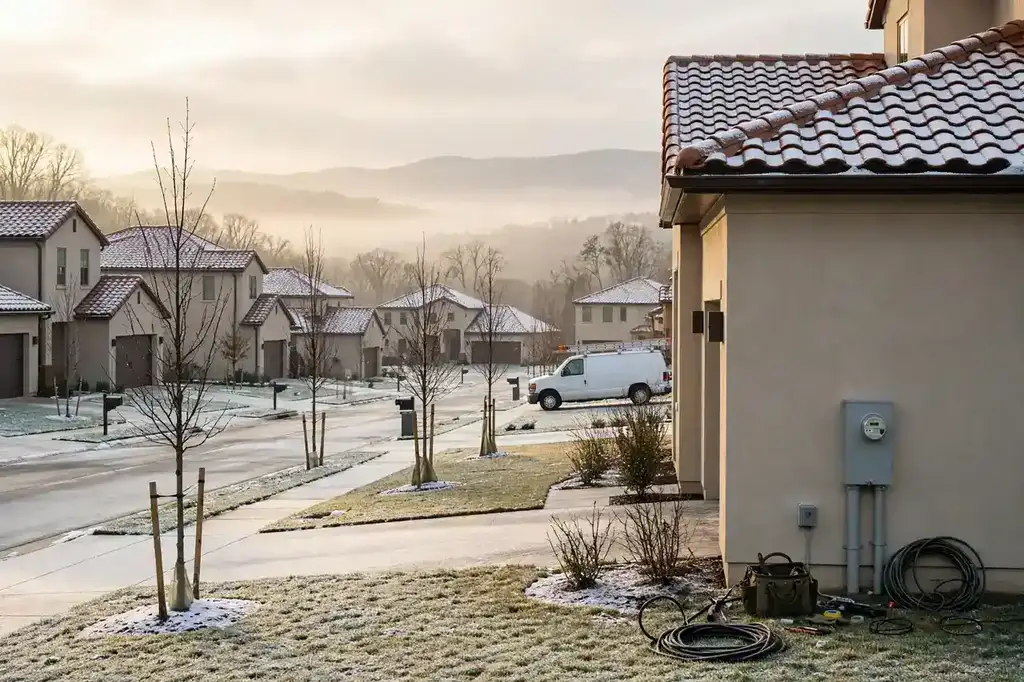
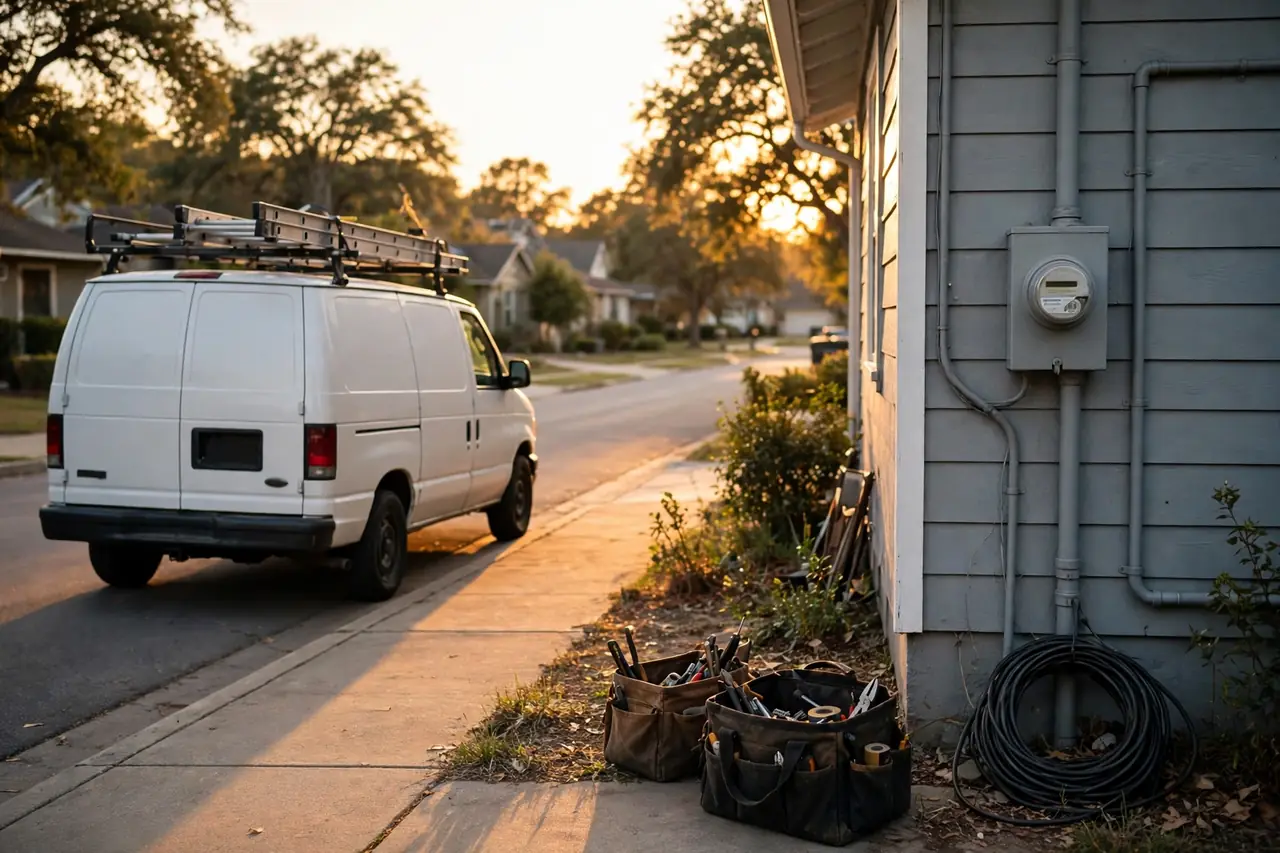
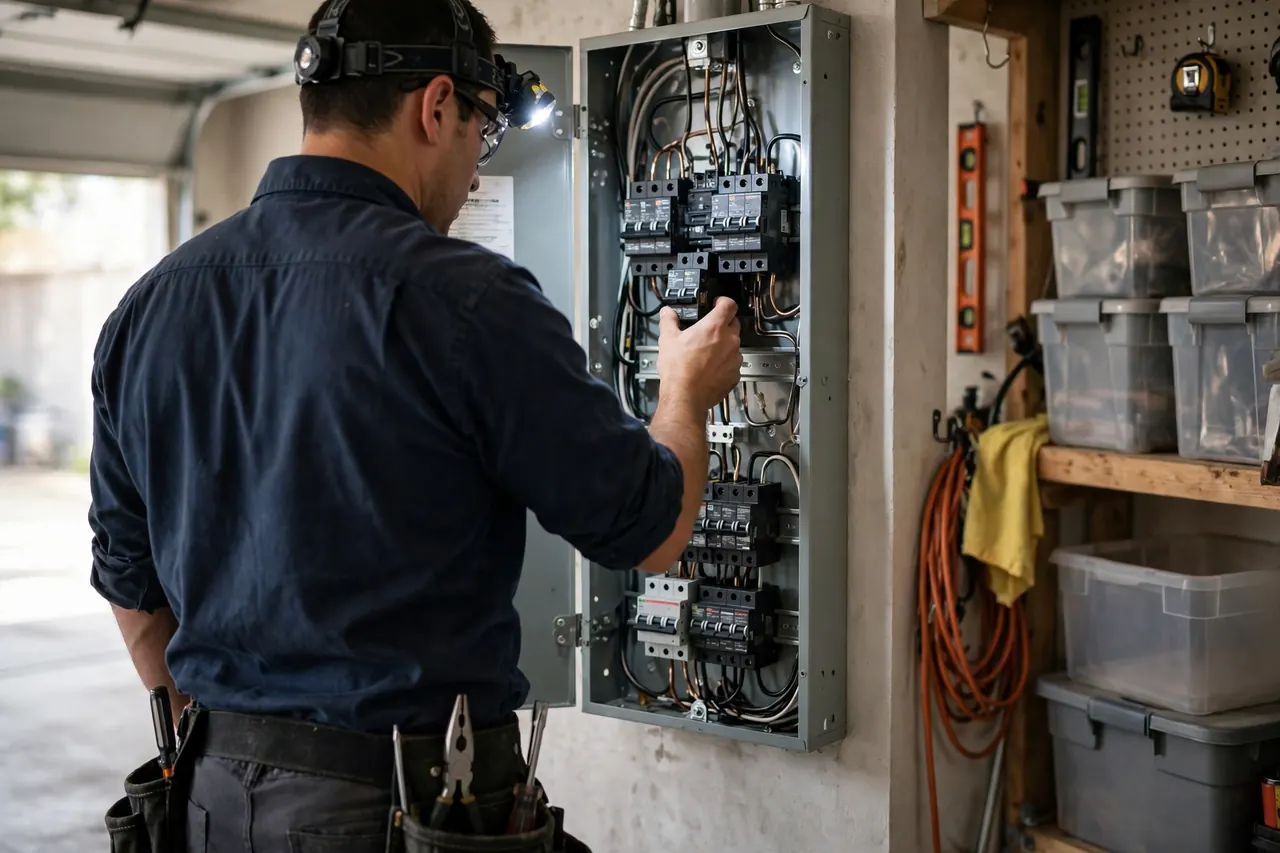
Asheville, NC — electrical help across the metroA service van between calls in AshevilleUpgrading a panel in a Asheville home
Asheville electrical work, in brief
The median Asheville home was built in 1989; 37.4% of the stock predates 1980, and the pattern this metro's own data ranks first is heating load strain in asheville. VoltReach USA is a referral service, not an electrical company: one call connects you with an independent local electrician serving your ZIP code.
The Asheville housing stock, and what it means for wiring
Two numbers frame everything that follows: 68.2% of Asheville homes are owner-occupied, and the median one was built in 1989. Ownership matters to electrical systems because owners inherit them whole — every decision a builder made in the 1980s or earlier is still behind the walls, ageing on its original schedule. With 37.4% of homes predating 1980 and 31.4% arriving since 2000, the metro is really two housing stocks sharing one map, and they are taken separately below before the problems are ranked.
There is a wiring timeline buried in Asheville's housing figures, and it reads like an electrician's diary. The 37,737 homes from before 1960 carry the oldest generations — knob-and-tube in the survivors, cloth insulation, fuse boxes in a few. The 37,336 that followed between 1960 and 1979 mixed copper with the aluminum branch-wiring years. Then came the 62,427 homes of 1980-1999, wired in copper with breaker panels as standard. Each band of that timeline is now a band of characteristic failures, arriving in the order the materials tire — which is why a home's build year, in this metro, is the single most predictive fact about its electrical system.
The growth side of the metro tells the opposite story in the same language. Hendersonville, Black Mountain and the subdivisions still filling in account for much of the 63,029 homes built since 2000 — modern panels, grounded circuits, AFCI protection in the bedrooms. Their electrical systems are not old; they are uniform, which creates its own calendar: everything installed in the same boom reaches each wear point in the same years, from the first detector replacements to the first panel-capacity conversations, while 1,092 cooling degree days of annual heat keep demand on the system high.
Over everything sits the weather, and here it is measured rather than described: NOAA's station at ASHEVILLE, NC US averages 57.3 degrees across the year, with 15.7 days reaching 90 or more and 76.9 nights at freezing or below. A panel feels that record as load that swings with the seasons; a circuit feels it on the single coldest night when every heater in the house runs at once; a service line feels it in the storm weeks. The problem ranking below is what those numbers, crossed with the housing profile, produce for Asheville specifically.
The Asheville electrical profile in numbers
The metro's building eras on one side, its weather record on the other — and its wiring where the two meet.
The distribution, in one breath: of every hundred Asheville homes, 18.8 were standing before 1960, 18.6 went up in the two decades after, 31.1 in the two after that, and 31.4 have arrived since 2000. Percentages flatten the picture, so hold the counts beside them — 37,737 oldest-era homes, 63,029 newest — and the metro's electrical systems stop being an abstraction: that many panels, that many wiring generations, ageing in that order.
Growth defines Asheville: the largest share of its housing was built from 2000 onward, 31.4 of the stock and 63,029 homes, lifting the median year to 1989. These homes generally arrived with 200 amp panels, grounded circuits throughout, modern protection and garages and layouts that anticipate vehicle charging in Asheville, Hendersonville and Black Mountain. The electrical questions in Asheville, North Carolina are therefore about first-wave ageing rather than legacy systems: original devices, breakers and smart equipment installed in Buncombe at construction are now reaching replacement age together, and added loads continue to accumulate on otherwise sound systems. It also shifts everyday questions toward integration, how chargers, storage, controls and appliances share a capable panel without nuisance trips or overloaded individual circuits.
Housing from 1980 to 1999 is the second-largest presence in Asheville, 62,427 homes spread through Asheville, Hendersonville and Black Mountain. Electrically these are transitional homes in a useful sense: copper wiring and breaker panels throughout, ground-fault protection beginning in wet areas, but capacities of 100 to 150 amps that modern loads press against. In Buncombe, this band often produces the most straightforward assessments in Asheville, North Carolina, because the systems are coherent and documented by their era, with age and added demand, rather than obsolete methods, as the main considerations. Streets in Fletcher built in this wave are a familiar sight during breaker and capacity assessments across the working week.
Climate completes the electrical profile of Asheville, North Carolina. The ASHEVILLE, NC US record shows 3,879 heating degree days and 1,092 cooling degree days, a 57.3 average temperature, 15.7 days at or above 90 degrees and 76.9 days at or below freezing. Together those numbers describe how hard heating and cooling systems, the two largest electrical loads in most homes in Asheville, Hendersonville and Black Mountain, must work across 161,494 households. Add 40.61 of annual precipitation and the storm exposure that comes with it, and the picture is of systems in Buncombe that are loaded heavily, in both directions, for much of the year. Independent local electricians therefore read nameplate loads against the local peak, not the annual average, when they judge a panel in this metro.
The method behind this profile is deliberately simple for Asheville: rank the housing eras by their share of the stock, rank the climate loads by the ASHEVILLE, NC US record, and read the two together. Where the largest era and the heaviest load overlap in Asheville, Black Mountain and Fletcher, the characteristic electrical questions of Asheville, North Carolina appear. That is why two metros with similar housing can feel different in practice, and why independent local electricians in Buncombe ground their assessments in both the build year of the home and the seasons it must endure.
Electrical problems Asheville homes actually get
Chosen by this metro's own housing and weather data — the same two records this whole page is built from.
Heating Load Strain in Asheville
Space heater use in Asheville calls for plain, respectful guidance, because people use them for real reasons: a cold nursery, a room the heating system reaches poorly, a workspace in Asheville. The electrical facts are these. A heater should be the only significant load on its circuit, plugged directly into a wall outlet rather than an extension cord or strip, kept clear of bedding and furnishings, and turned off when the room is empty or everyone sleeps. If a heater trips a breaker in a Asheville home, that circuit is telling you it cannot carry the heater alongside its other duties. The durable answers are a dedicated circuit where heaters are routine, or heating improvements that remove the need — both conversations an electrician can start.
If heating trips a breaker repeatedly in a Asheville home, treat the pattern carefully. Resetting once and watching is reasonable for many households. Repeated trips, a breaker that will not hold, warmth or smell at the panel, or discoloration at the heating disconnect are signs to stop resetting and call an electrician, because a breaker that keeps tripping under a sustained heating load is reporting a condition that resetting cannot fix. Keep the house as warm as the remaining system allows, use any heater you do run on a circuit of its own and attended, and give the electrician in Asheville the timeline of trips and temperatures when you call.
There is also a building condition thread in Asheville worth naming. On the coldest nights, heating systems run without pause, and every connection in the heating circuit carries sustained current for many hours. Sustained current is what finds weak points: a loose termination in a disconnect in Black Mountain, a tired breaker in a panel in Fletcher, insulation on conductors aged by decades of heat cycles. A fault that smoulders electrically at low load declares itself at full load. That is why winter calls in Buncombe so often involve heating circuits and panels rather than lighting or outlets, and why a pre season check of heating circuits in Asheville is worth more than the same check in spring.
Consider how an electrician untangles a problem circuit in a Asheville home, step by step in plain language. First, identify everything on the circuit, including the outlets and lights a homeowner forgot were connected. Second, note which combinations were running when trips occurred. Third, inspect the breaker, terminations and a sample of devices for heat or wear. Fourth, decide whether the load, the layout or a fault explains the evidence. Only then come options: moving a load, adding a circuit from the panel if capacity allows, or repairing what the inspection found. Homeowners in Asheville who follow that sequence once tend to trust it, because each recommendation visibly follows from something that was shown, not asserted.
Extension cords and multi outlet strips deserve a direct word in Asheville, because they are where overload quietly concentrates. A strip that gathers a heater, entertainment equipment and chargers onto one receptacle in Hendersonville can load a single outlet and its circuit heavily while looking tidy. Cords are for temporary use; used permanently, especially coiled or under rugs, they add heat and wear points the circuit was never planned around. An electrician assessing an overloaded room in a Asheville home will often recommend additional receptacles on suitable circuits as the durable fix, so the room's layout invites safe use instead of workarounds that gather load in one place.
There is a subtler sign of strain across Asheville that deserves attention alongside tripping: circuits that never quite trip but run near their limit for hours. Lights dim briefly when a compressor or dryer starts in Asheville. An outlet strip in Hendersonville feeds a heater, a television and chargers because the room has too few receptacles for its current use. None of that announces itself as a fault, yet it describes a layout stretched past its intent. With 68.2 of Asheville homes owner occupied, many residents have adapted gradually to these workarounds and stopped seeing them. Naming the pattern is the first step toward a circuit layout that fits the house as it is lived in now.
Storm related electrical work in Asheville divides into three phases, and keeping them separate brings clarity. Before a storm, the work is preparation: a sound panel, secure service equipment, surge protection in place, and a generator connection arranged properly if one is planned. During an outage, the priorities are safety — treating all lines as live, keeping generators outdoors and away from windows, and keeping water away from electrical equipment. After restoration, the work is assessment: watching for damage the event left behind and having suspect equipment inspected. Independent local electricians in Asheville help with the first and third phases, and their advice shapes how a household handles the second.
If a service drop or meter equipment at a Asheville home is damaged in a storm, the division of responsibility matters and confuses many homeowners. Some equipment belongs to the utility, some to the homeowner, and the boundary usually sits around the meter and service mast. An electrician can identify which parts are the homeowner's to repair and coordinate the sequence so utility reconnection happens once work passes inspection where required. Knowing that sequence in Asheville prevents the frustration of arranging the wrong repair first. When in doubt after storm damage in Hendersonville or Woodfin, ask an electrician to identify ownership of the damaged part before authorising any work.
Generators enter the Asheville picture because outages here can outlast the food in a refrigerator and the patience of anyone working from home in Woodfin. After a major event, enquiries about generators spike across Buncombe, and with them a set of safety questions that deserve calm answers before the next storm rather than hurried ones during it. How a generator connects to a house — through a transfer switch or interlock arranged by an electrician, never by improvised cords — determines whether it powers selected circuits safely without endangering the household or line workers restoring supply in Asheville. Planning that connection in fair weather is the pattern's practical lesson.
Finally, charging readiness in Asheville is sensibly seen as part of a home's ongoing electrification, not an isolated purchase. The homeowner who asks about capacity for a vehicle today is often the same one who will ask about a heat pump or an electric range next, and the load calculation done properly now becomes the baseline for those later questions. Keeping its results with household documents in Asheville saves repeating the work. VoltReach USA connects homeowners with independent local electricians who think in those terms: install the charger correctly, document the panel's remaining capacity honestly, and leave the household with a clear picture of what its electrical service can welcome next, whether that arrives next year or next decade.
Two electric vehicles change the arithmetic for a Asheville household in a way worth planning early. Two chargers running overnight together can rival the rest of the house combined, yet managed equipment can share capacity intelligently, alternating or balancing draw so both vehicles are ready by morning without exceeding the service. A homeowner in Black Mountain expecting a second vehicle should raise it during the first installation conversation, because provision made then — panel space, routing, managed equipment choice — is simpler than revisiting the work. Electricians in Asheville see this sequence often enough that asking about future vehicles has become a standard part of a thorough readiness visit.
Look at driveways across Asheville in the evening and the pattern explains itself. Vehicles that once only consumed fuel now consume household capacity, and they do it at the same hours when heating or cooling, cooking and laundry already peak seasonally against 1,092 cooling degree days. The electrical question in a Asheville home is therefore about timing as much as size: a managed or scheduled charging arrangement draws overnight, when the house is quiet, while an unmanaged one can add its full draw to the evening peak. Electricians discussing charging in Buncombe, Henderson, Madison talk through that daily rhythm as part of planning a sound installation.
There is a readiness side to freeze season in Asheville that goes beyond heating itself. An outage in deep cold is a different event from an outage in May, because the house begins cooling toward a freeze from the moment heat stops. Households in Black Mountain and Fletcher do well to know in advance what a generator arrangement would and would not carry, where the main disconnect is, and which circuits matter most if power is limited. After any freeze in which water has moved inside the structure in Asheville, electrical equipment it reached should be inspected before being trusted. Small preparations, made in mild weather, are what separate a difficult night from a damaging one.
When sustained cold settles over Asheville, the electrical system works differently. Heating equipment that cycles briefly in mild weather runs almost continuously, auxiliary strips add heavy draw during the coldest hours counted among 76.9 freezing days at ASHEVILLE, NC US, and households in Hendersonville and Black Mountain add space heaters room by room. In homes built in the 1980s across Buncombe, that load lands on circuits planned for far less. Flicker when the heating starts and trips that happen only before dawn are useful clues. Independent local electricians can assess heating load and circuit condition in Asheville homes during freeze season.
A closer look: heating load strain in asheville in Asheville
Sustained current changes the failure physics in Asheville in a way worth understanding. Connections throughout a heating circuit — breaker stabs, lugs, disconnect contacts, equipment terminals — each carry a small resistance. At brief loads, the heat that resistance generates dissipates harmlessly. At the multi hour full draw of a cold night in Buncombe, heat accumulates faster than it sheds, temperatures at marginal connections climb, and materials age or fail at the warmest point first. This is why a connection can serve for years and fail in a single cold snap: the snap is the first time duration and current combined crossed its threshold. Electricians inspecting after such a failure in Asheville look along the whole heating path, not just at the failed point, because other connections of the same age and type have lived the same life and deserve the same scrutiny before the next cold night tests them.
Read the ranking backwards and it reads as a data summary: 410,817 residents in 200,730 housing units, 18.8% of the housing from before 1960, 40.61 inches of rain in an average year. The pattern leads because the exposure is broad — counted not in individual unlucky houses but in whole eras of the metro's building, stacked one on another.
On a first visit for this pattern, a local electrician's checks run in a practised order:
Look for discoloration along the heating path
Verify main breaker condition under load history
Check circuits in the coldest rooms for overload
Assess generator coverage for heating essentials
Examine panel for signs of sustained heat
Advise on load staggering during cold snaps
Electrical services in Asheville
Ordered by what this metro's data says its homes need most.
Emergency Electrician in Asheville
In Asheville, sparking, smoke, or a burning smell from an outlet or panel means act on safety first. VoltReach USA routes your description to an independent local electrician who can assess the home wiring in person.
Some electrical problems in Asheville become urgent because of what the household depends on. Powered medical equipment, refrigerated medication, a well or sump system, remote work that cannot pause, or very young or elderly residents can turn a modest fault into a pressing one for a particular family in Buncombe. With 410,817 residents and 161,494 households, those circumstances are common and deserve to be stated plainly when seeking help. Independent local electricians can prioritise restoring the circuits a Asheville household depends on most, once the situation is safe, and explain any temporary limitations honestly rather than promising a full restoration that conditions do not allow. Owners in Hendersonville are advised to unplug sensitive electronics during a serious fault, protecting equipment while the cause is investigated. Across 32 ZIP codes in Asheville, North Carolina, homeowners who start with a clear evaluation, grounded in the age of the property and its 1989 era context, are well placed to decide what should happen now and what can be planned for later with independent local electricians.
Urgent faults in Asheville arise from a stock where 75,073 homes predate 1980 and the median build year is 1989, spread across 32 ZIP codes in 3 counties. Ageing systems meeting modern load is the recurring local pattern in Buncombe. Independent local electricians can make a Asheville, North Carolina home safe, isolate the fault and explain the likely role of the system's age and condition.
A loose, hot, or damaged breaker in Asheville, North Carolina is not something to keep resetting. Among 200,730 local housing units, panel age varies widely, and VoltReach USA connects residents with independent local electricians who can inspect the equipment and describe what they find.
Households in Asheville keep adding load to circuits that were laid out for a lighter life. A microwave and an air fryer sharing a kitchen circuit, a space heater joining a bedroom circuit already carrying computers, or workshop tools on a garage circuit can push a healthy breaker to its limit without anything being broken. With 200,730 housing units and 68.2 owner occupancy, these patterns are everyday occurrences in Buncombe. Independent local electricians can map what actually runs on a tripping circuit in a Asheville home, measure load where appropriate, and discuss redistributing appliances or adding capacity as distinct options from repairing the breaker itself. Owners in Hendersonville should note whether trips coincide with heating or cooling starting, because motor start-up draws heavily for a moment. In a metro of 161,494 households and 200,730 housing units, no two properties in Asheville present quite the same picture, which is why independent local electricians assess each home in Buncombe, Henderson, Madison on its own wiring, panel and patterns of use.
Breaker trips in Asheville often cluster at seasonal peaks recorded at ASHEVILLE, NC US: 15.7 hot days driving cooling load and 76.9 freezing days driving heating load, within 1,092 cooling and 3,879 heating degree days annually. That timing is diagnostic. Independent local electricians can use when a Asheville household reports trips to focus testing on the circuits and loads most likely involved in Buncombe, Henderson, Madison.
Households in Asheville, North Carolina dealing with Heating Load Strain in Asheville or overloaded circuits in Asheville during outages often want a permanent answer rather than extension cords. Independent local electricians can size a system around the circuits that matter to you. Discussing those needs openly at the start helps the electrician size the transfer equipment honestly, rather than selling capacity the household will never actually use.
The case for backup power in Asheville, North Carolina is written in its weather record. Data from ASHEVILLE, NC US showing 40.61 of precipitation, 76.9 freezing days, 15.7 hot days and 3,879 heating degree days describe a metro where outages can coincide with the very conditions a household can least afford to sit through without power. Refrigeration, medical equipment, sump and well equipment where present, heating controls and simple lighting all become priorities at once. Homeowners across Buncombe, Henderson, Madison often explore generator installation after a memorable outage. Independent local electricians can help a Asheville household rank essential loads honestly and size a plan around those priorities. Households in Black Mountain that rely on well or sump equipment usually place those circuits high on their essential list from the outset. For households in Asheville, Hendersonville and across Buncombe, the practical next step is an assessment by independent local electricians who can relate the work to a Asheville home built in the 1980s and to the loads it carries today.
Housing age matters for generator placement in Asheville: 75,073 homes built before 1980 and 62,427 built from 1980 to 1999 present varied panel locations and lot layouts across 32 ZIP codes. Independent local electricians can survey a Asheville property in Buncombe, note panel configuration and clearances, and explain how transfer arrangements would fit that particular home rather than a generic layout.
With 68.2 of households in the Asheville area owning their homes, many owners plan charging as a long-term improvement alongside the vehicle itself. A dedicated, properly sized circuit is the foundation that later vehicles can also use. A dedicated circuit installed for this purpose also keeps the garage's ordinary outlets available for tools, freezers, and everything else the household plugs in there.
For many households in Asheville, a charger is only the most visible of several new loads arriving together. Home offices, workshop tools, hot tubs and upgraded kitchens all compete for the same service, and 68.2 owner occupancy means owners are planning for years of use, not a single season. A thoughtful installation in Buncombe therefore starts with the whole-home picture across 200,730 housing units in the metro, not just the garage wall. Independent local electricians can inventory existing large loads, discuss future plans a homeowner in Asheville may have, and explain whether load management or added capacity belongs in the conversation before the charger itself is mounted. Owners in Hendersonville who charge overnight on a time-of-use routine may arrange the circuit and controls around that pattern from the start. Owner-occupiers, 68.2 of households in Asheville, often plan electrical work alongside other projects, and independent local electricians can help sequence it sensibly for a property in Buncombe so walls are opened once and circuits are planned as a whole.
Homes built since 2000 number 63,029 in Asheville, 31.4 of 200,730 housing units, while 75,073 homes predate 1980. That split across Buncombe explains why charging assessments differ so much between newer subdivisions and older streets in Asheville, North Carolina. Independent local electricians can place a specific garage and panel within that local pattern before advising on a dedicated circuit.
Two-prong outlets, warm switches, or Heating Load Strain in Asheville in a Asheville home can point to wiring that needs attention. A local electrician serving Asheville and Hendersonville can explain full and partial rewiring options.
In Asheville, North Carolina, panels installed for the the 1980s era often meet today's loads in Buncombe. VoltReach USA connects homeowners with independent local electricians who can evaluate capacity and condition in person.
Storms and switching send spikes through Asheville, North Carolina wiring. VoltReach USA refers homeowners to independent local electricians who explain panel protection and how it layers with plug-in devices.
Dark counters, glare, or switches in the wrong place in a Asheville home are design problems with electrical solutions. Local electricians serving Asheville and Hendersonville can rework layout, fixtures, and dimming.
Wobbling or noisy fan in a Asheville home? The ceiling box or bracket is often the cause. A local electrician can inspect the support, correct it, and install a fan that runs smoothly and quietly.
Need more outlets or GFCI protection in Asheville, North Carolina? VoltReach USA refers homeowners to independent local electricians who plan device work around your rooms and circuits.
In Asheville, every level and sleeping area needs working detectors. VoltReach USA connects homeowners with independent local electricians who install, interconnect, and test units across the home.
Recurring trips or lighting failures in Asheville premises deserve a whole-site assessment. VoltReach USA connects you with an independent local electrician who explains findings in plain language.
If this page's services were ranked by Asheville's call patterns rather than listed in catalogue order, they would come out much as they do here — because the ranking behind them is data, not habit. Heating Load Strain in Asheville leads the metro's problem table and overloaded circuits in Asheville follows, so the services answering them lead the list. The long tail of a metro's electrical life — device failures, lighting calls, the one circuit nobody can explain — fills in the diary around them, here as everywhere.
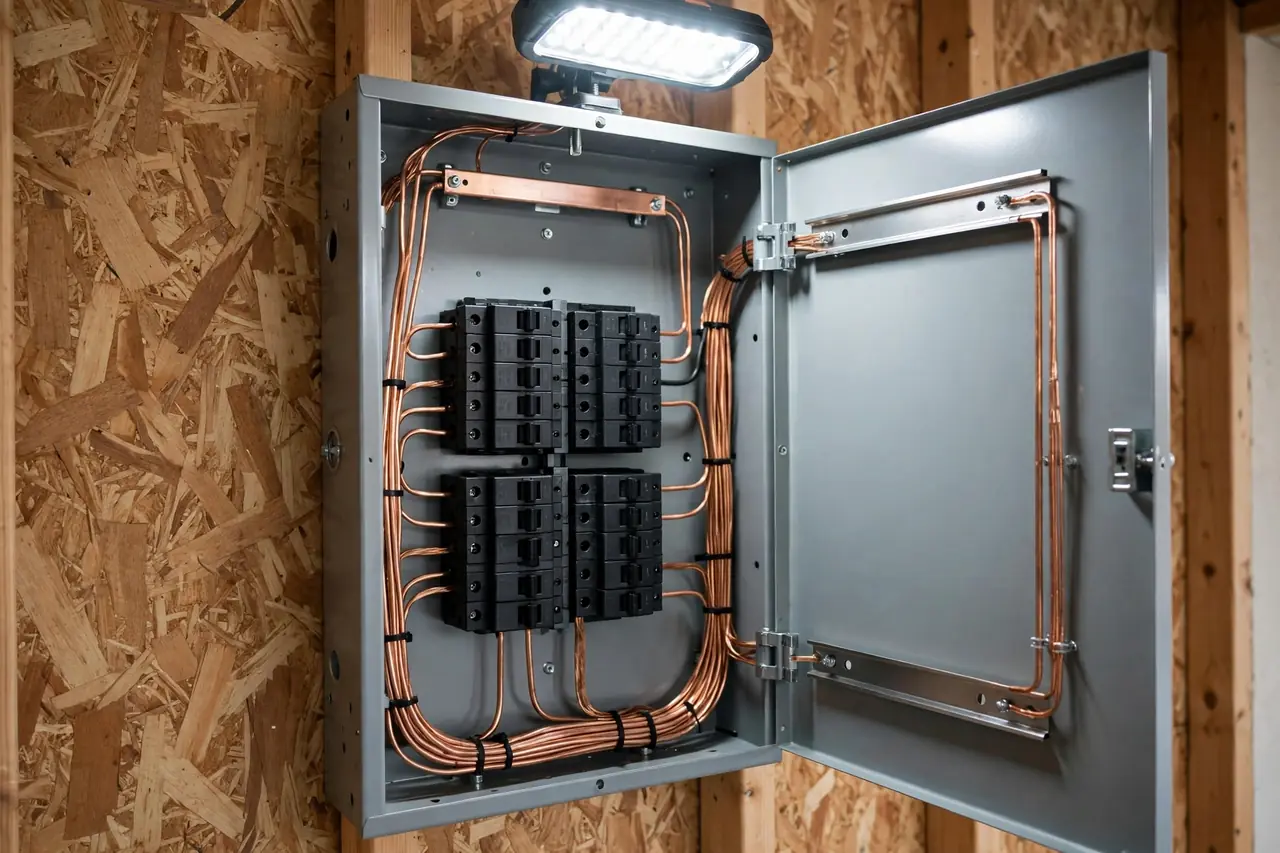
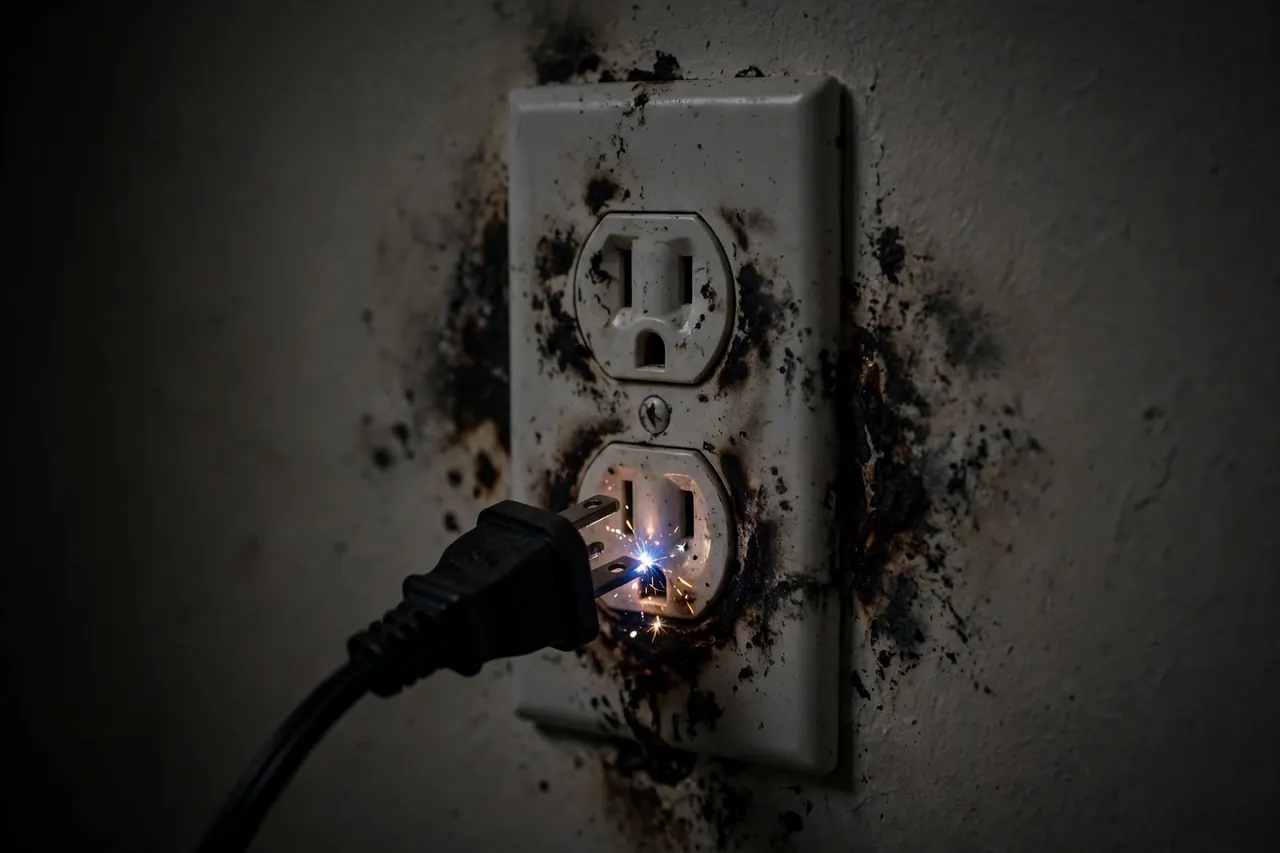
From problem to fixed, in Asheville
PROBLEMAn electrical problem inside a Asheville home
➔
SOLUTIONThe same system in Asheville after professional repair
Areas covered in the Asheville metro
Asheville
Population 94,369
Hendersonville
Population 15,253
Black Mountain
Population 8,462
Fletcher
Population 8,022
Woodfin
Population 7,957
Etowah
Population 7,765
Mills River
Population 7,214
East Flat Rock
Population 6,468
Swannanoa
Population 6,043
Weaverville
Population 4,618
Royal Pines
Population 4,528
Dana
Population 3,824
Also in the Asheville metro: Mountain Home (population 3,518), Flat Rock (population 3,502).
Read the grid as a building programme spread over a century. The oldest communities sit where the metro began; the youngest are still adding streets at its edge; and Hendersonville and Black Mountain, with 15,253 and 8,462 residents, stand for the rings in between. Each ring wired in its era's materials, and each is now ageing, wearing or holding in its era's characteristic order. The ZIP codes below draw the coverage boundary; the eras inside it draw everything else on this page — the problems ranked, the services ordered, the checks advised.
Also on the Asheville map: Fletcher (8,022), Woodfin (7,957), Etowah (7,765), Mills River (7,214), East Flat Rock (6,468) — communities spread across Buncombe, Henderson, Madison, each with housing from its own growth years. An electrician routed through VoltReach USA to any of them is working from this same page: the metro data does not change at the city limit, but the housing on your street — its age, its wiring, its panel — is what the visit is really about.
Asheville (94,369 residents) anchors the metro, and Hendersonville (15,253) is its second centre of gravity. Between them they hold the bulk of the 161,494 households — and, not coincidentally, the bulk of every housing era this page discusses, from the pre-1960 core to the newest subdivisions. Black Mountain (8,462) and the communities beyond it repeat the same eras at smaller scale.
Draw the metro by its paperwork and it resolves into Buncombe, Henderson, Madison — 3 jurisdictions sharing one housing stock and one weather system. Buncombe County holds the historic centre and the densest share of the older homes; the surrounding counties hold the rings of growth around it. Permits and inspections follow those boundaries even though current never does, which is part of why the electrician this page connects you to works these streets specifically.
This page ends at the metro boundary, but the region does not: Hickory, NC, Charlotte, NC and Winston-Salem, NC continue the coverage in their own directions, each with a profile built from its own Census and NOAA figures. If your home sits near the line between metros, go by your ZIP code — it places you in the dataset that describes your housing.
The region around Asheville is a set of variations on its theme: Hickory, NC, 67 miles off, runs a median build year of 1983 on a metro population of 376,890; Charlotte, NC (103 miles) medians 1994 on 2,938,830; Winston-Salem, NC (127 miles) medians 1984 on 712,206. Nearness is not sameness — a few decades of median build year separate their wiring as surely as the miles separate their maps.
Count the metro per unit of itself: 6,273 housing units per covered ZIP code; 53,831 households per county; 14 communities sharing 3 county governments. Then weigh the generations against each other — 1.2 older homes for each newer one — and the service pattern on this page stops being a list and becomes a proportion: that much of the diary written by ageing systems, the rest by young ones wearing in.
The Asheville record in one line — median home age: 37 years · owner-occupied homes: 110,139 · renter-occupied homes: 51,355 · pre-1960 homes per covered ZIP code: 1,179 · heating-to-cooling degree-day ratio: 3.55 · average rainfall: 1,031 mm a year.
Asheville electrical questions
Is my neighbourhood in Asheville inside the VoltReach USA coverage area?
Coverage on this page is defined in a plain, checkable way: if your ZIP code appears in the 32 codes listed for Asheville, North Carolina, and your home sits inside Buncombe, Henderson, Madison, you are inside the area this page was built for. VoltReach USA is a referral service, so coverage means the page can connect you with an independent local electrician who works in that territory, not that VoltReach itself sends a crew. Start by matching your code against the list, then check your county against Buncombe and the neighbouring counties named above. If both line up, use the contact route on this page and describe your panel, circuit or wiring concern in your own words. The population behind the boundary underlines its scale: 161,494 households in 200,730 homes across Buncombe, Henderson, Madison, with 68.2% owner-occupied, means the coverage list is not a token gesture toward Asheville but a working map of where local homeowners actually live, street by street and code by code, throughout the metro this page describes in its housing and weather research above. For the record in its most compressed form, 28701, 28704, 28709, 28710 open the code list for Asheville, the era ledger runs from 37,737 pre-1960 homes onward, and the largest community, Asheville, counts 94,369 residents within a metro population of 410,817 recorded for this page. Stated as a list of codes: the codes run 28701, 28704, 28709, 28710 and 28711 among the 32 on the list, spread over Buncombe, Henderson, Madison. Read it against a median build year of 1989 and a 37.4% share of homes from before 1980. The weather record behind it is ASHEVILLE, NC US's: 3,879 heating degree-days against 1,092 cooling degree-days in an average year. Run the same ranking for nearby Hickory and its leading pattern is heating load strain - a different order from Asheville's, which is why this site keeps a separate page for every metro. The footprint takes in Buncombe County, Madison County and Henderson County - 3 covered counties in all, each with its own page on this site. It is written for a metro whose largest places are Asheville (94,369 residents), Hendersonville (15,253) and Black Mountain (8,462).
Which homes in Asheville need the closest eye on panels and wiring?
The homes that deserve the closest watch in Asheville are the oldest ones, and the figures explain why. Some 18.8% of local homes were built before 1960 and 37.4% before 1980, which means a large share of the stock has lived through several generations of wiring, panel design and household demand. A panel fitted when a home ran a handful of circuits now often feeds kitchen appliances, laundry equipment, heating controls and electronics its makers never pictured. Watch older homes for breakers that trip under ordinary loads, warm outlet covers, flicker when large appliances start, and circuits that seem to carry a whole floor. Age alone is not a verdict, but it is the strongest prompt for a careful look. Geography sharpens that watch list across the Asheville metro, because the oldest stock is not spread evenly: it concentrates in and around Asheville and the earlier-settled parts of Buncombe, while the places that grew later, among them Fletcher and Woodfin, carry younger panels and wiring on average, so two streets with the same postal city can sit a generation apart electrically across the 32 codes and 3 counties this page covers. Scale matters here as well: a metro of 410,817 residents in 200,730 homes where the median build year is 1989 cannot treat older-system watchfulness as a niche concern, since the pre-1980 share touches whole districts at once, and the households in those districts share not only an era of construction but the same generation of panels, circuits and wiring decisions made when their streets were first built. The compressed watch list for Asheville reads by numbers: codes from 28701 to 28710 contain districts where 37,737 pre-1960 homes and 37,336 homes from 1960 to 1979 cluster, while Asheville, at 94,369 residents, holds the densest share of the oldest wiring in the metro. For the watch list stated by community: the community ledger reads Asheville (94,369 residents), Hendersonville (15,253), Black Mountain (8,462), Fletcher (8,022) and Woodfin (7,957), out of 410,817 residents metro-wide. The coverage behind this answer spans ZIP codes 28701 through 28726 - the ZIP list published on this page. The footprint takes in Buncombe County, Madison County and Henderson County - 3 covered counties in all, each with its own page on this site. Run the same ranking for nearby Greensboro and its leading pattern is heating load strain - a different order from Asheville's, which is why this site keeps a separate page for every metro. The weather record behind it is ASHEVILLE, NC US's: 3,879 heating degree-days against 1,092 cooling degree-days in an average year. It is written for a metro whose largest places are Asheville (94,369 residents), Hendersonville (15,253) and Black Mountain (8,462).
Which electrical fault turns up most often in Asheville homes?
For Asheville, the problem ranking puts Heating Load Strain in Asheville first and overloaded circuits in Asheville second, and the reasoning sits in the age of the homes themselves. A stock with 37.4% of homes built before 1980 carries a great deal of wiring and panel equipment into a period of demand it was not shaped for. Add the weather load described on this page and circuits spend long stretches working hard, which is when marginal breakers, tired connections and overloaded runs show themselves. Homeowners often describe the leading problem in everyday terms: power dropping in one room, a breaker that will not stay set, lights reacting when equipment starts. Those descriptions are the starting point. An electrician testing the circuit in person is what turns a description into a diagnosis. Put the leading problems against the ownership and era figures and the order steadies further: in a metro where 68.2% of homes are owner-occupied and 37.4% were built before 1980, the faults of ageing panels and circuits are not edge cases but the central experience of the stock, which is precisely the experience the ranking, led by Heating Load Strain in Asheville and followed by overloaded circuits in Asheville, was assembled to describe for Asheville. Behind the podium in compressed form: the code run 28701, 28704, 28709, 28710 spans districts built across every era in the ledger, Asheville alone holds 94,369 residents, and the load figures at ASHEVILLE, NC US, 3,879 heating and 1,092 cooling degree days, keep the circuits behind Heating Load Strain in Asheville working hard. With the leading problem stated against the era count: the era ledger reads 37,737 homes before 1960, 37,336 from 1960-1979, 62,427 from 1980-1999 and 63,029 since 2000 — 200,730 units, 161,494 households, 68.2% of them owner-occupied. The footprint takes in Buncombe County, Madison County and Henderson County - 3 covered counties in all, each with its own page on this site. The coverage behind this answer spans ZIP codes 28701 through 28726 - the ZIP list published on this page. The weather record behind it is ASHEVILLE, NC US's: 3,879 heating degree-days against 1,092 cooling degree-days in an average year. All of it describes the Asheville metro as the Census defines it - 410,817 residents in 200,730 housing units. Run the same ranking for nearby Burlington and its leading pattern is heating load strain - a different order from Asheville's, which is why this site keeps a separate page for every metro.
How does Asheville's weather affect home electrical systems?
Think of Asheville weather as a load test that repeats every year. The station record at ASHEVILLE, NC US, with 40.61 of precipitation, an average of 57.3, and the seasonal spread between 3,879 heating degree days and 1,092 cooling degree days, describes a test your panel and circuits sit annually whether you plan it or not. Systems with capacity to spare pass quietly. Systems already near their limits announce themselves during the test: breakers trip on the hottest afternoons, circuits complain on the coldest nights, and outdoor fittings fail after wet spells. That timing is useful information. If a fault keeps the same season as the weather that triggers it, tell an electrician exactly that. Seasonal timing is one of the clearest clues in household electrical diagnosis. That weather story also changes across the metro itself, from the denser streets of Asheville to the more open ground around Fletcher and Woodfin: exposed service lines, older outdoor fittings and long cooling or heating runs are distributed unevenly across Buncombe, Henderson, Madison, so a storm or a heat spell that barely troubles one part of Asheville can be the event that exposes tired circuits and weathered outdoor outlets in another part of the same metro. The household numbers give the climate figures their human scale in Asheville: 161,494 households experience the same 3,879 heating degree days and 1,092 cooling degree days through very different buildings, from pre-1960 homes with original circuit layouts to post-2000 homes built for present loads, so identical weather produces gentle service in one home and repeated breaker trips in the next, purely through the building it passes through. The station figures in their densest form for Asheville are these: ASHEVILLE, NC US records 57.3 on average, 15.7 days at the top of the heat range, 76.9 at freezing or below, and 40.61 of precipitation, numbers that between them govern load, cycling and moisture for every circuit in the metro. With the weather load stated by community: the community ledger reads Asheville (94,369 residents), Hendersonville (15,253), Black Mountain (8,462), Fletcher (8,022) and Woodfin (7,957), out of 410,817 residents metro-wide. Read it against a median build year of 1989 and a 37.4% share of homes from before 1980. The weather record behind it is ASHEVILLE, NC US's: 3,879 heating degree-days against 1,092 cooling degree-days in an average year. All of it describes the Asheville metro as the Census defines it - 410,817 residents in 200,730 housing units. The footprint takes in Buncombe County, Madison County and Henderson County - 3 covered counties in all, each with its own page on this site. Run the same ranking for nearby Charlotte and its leading pattern is overloaded circuits - a different order from Asheville's, which is why this site keeps a separate page for every metro.
I can smell burning near an outlet in my Asheville home. What comes first?
Treat a burning smell or sparks as a stop signal, not a puzzle to solve. Stop using the outlet, keep hands away from it, and move anything plugged into it only if the plug and outlet are cool, dry and undamaged to the touch. Keep children and visitors clear of the room if the smell is strong. Switching the circuit off at the breaker is a sensible step only when the path to the panel is clear, the floor is dry, and the panel shows no heat, buzzing, scorching or moisture. If any of those signs are present, leave the panel alone. Flames, spreading smoke, a fallen service line or a strong smell filling the home all mean the same thing: get out and call emergency services, then the utility for anything involving lines outside. An electrician visit comes after safety, arranged once the scene is calm. If this happens in your Asheville home, remember that help is organised locally: the coverage area on this page spans 32 ZIP codes across Buncombe, Henderson, Madison, from Asheville to Woodfin, and the electrician you are connected with works in that same territory, so give your ZIP code and your community name when you make contact after the immediate danger has passed, because that detail routes your enquiry to the right part of the metro without delay. Once the immediate danger has passed, the details you pass on help more than you might expect: your ZIP code within the 32 listed for Asheville, the room involved, whether water was anywhere nearby, and whether the breaker stayed off, together let the independent electrician arrive understanding the circuit's story, and in a metro of 161,494 households that clarity is what separates a focused first visit from a second one. In the compressed local record, incidents like this are read against 75,073 pre-1980 homes, a code list opening 28701, 28704, 28709, 28710, and a station history of 15.7 hot days loading older circuits hard, context that explains frequency without ever changing the safe first steps themselves. After an incident, stated for the record by community: the community ledger reads Asheville (94,369 residents), Hendersonville (15,253), Black Mountain (8,462), Fletcher (8,022) and Woodfin (7,957), out of 410,817 residents metro-wide. The Census identity of this metro, Asheville with 410,817 residents, 68.2% owner-occupied and a median build year of 1989, explains why such incidents cluster in older circuits here compared with Hickory, NC at 67, Charlotte, NC at 103 and Winston-Salem, NC at 127: the podium faults Heating Load Strain in Asheville, overloaded circuits in Asheville and storm and outage damage in Asheville all grow from the same ageing stock that makes conservative first steps so important locally. The code walk also helps the electrician who follows up in Asheville: naming where in the sequence 28701, 28704, 28709, 28710, 28711, 28715, 28726 your home falls, together with the circuit involved and whether the breaker was left off, places the incident on the metro map at once, shortening the first conversation and letting the visit begin with the faulty circuit rather than with geography. Run the same ranking for nearby Winston-Salem and its leading pattern is heating load strain - a different order from Asheville's, which is why this site keeps a separate page for every metro. The housing ledger behind it counts 37,737 homes from before 1960 and 63,029 built since 2000 across the metro. The footprint takes in Buncombe County, Madison County and Henderson County - 3 covered counties in all, each with its own page on this site. The coverage behind this answer spans ZIP codes 28701 through 28726 - the ZIP list published on this page. Read it against a median build year of 1989 and a 37.4% share of homes from before 1980.
Rewiring or another repair: how is that decided for a Asheville home?
The dividing line is pattern against incident. A single fault with a clear local cause, a damaged outlet, a breaker at the end of its life, one circuit overloaded by one new appliance, usually belongs in repair territory. Rewiring enters the conversation when faults repeat across rooms served by the same generation of wiring, when insulation is crumbling wherever it is inspected, or when the wiring type itself, such as older aluminum branch wiring or surviving knob-and-tube runs, is the underlying issue rather than any single fitting. In Asheville, where 37.4% of homes predate 1980, that pattern question arises often. No page can settle it for your home. An electrician settles it by inspecting several points in the system and judging whether the faults share one root. The rewiring question lands differently across Asheville depending on which ring of the metro a home occupies: the pre-1960 core around Asheville and the older streets of Buncombe produce the pattern cases most often, the 1960 to 1979 suburbs through Hendersonville and Black Mountain produce the material cases, and the newer ground toward Fletcher and Woodfin produces mostly isolated repairs, a geography written by the 75,073 homes built before 1980 across 32 codes. The era percentages translate the rewiring judgement into local proportions for Asheville: 18.6% of homes from 1960 to 1979 and 18.8% from before 1960 together form the pool where system-wide findings concentrate, while the 31.1% from 1980 to 1999 and the share built since 2000 produce them far less often, so the same fault history carries different weight depending on which slice of the local stock your home occupies. Compressed, the renewal case in Asheville rests on the ledger: 37,737 homes before 1960, 37,336 from 1960 to 1979, districts running from code 28701 to code 28710, and a largest community, Asheville, whose 94,369 residents live amid the oldest wiring generations in the metro. On renewal, stated by the communities in question: the community ledger reads Asheville (94,369 residents), Hendersonville (15,253), Black Mountain (8,462), Fletcher (8,022) and Woodfin (7,957), out of 410,817 residents metro-wide. All of it describes the Asheville metro as the Census defines it - 410,817 residents in 200,730 housing units. The weather record behind it is ASHEVILLE, NC US's: 3,879 heating degree-days against 1,092 cooling degree-days in an average year. The coverage behind this answer spans ZIP codes 28701 through 28726 - the ZIP list published on this page. The footprint takes in Buncombe County, Madison County and Henderson County - 3 covered counties in all, each with its own page on this site. Run the same ranking for nearby Greensboro and its leading pattern is heating load strain - a different order from Asheville's, which is why this site keeps a separate page for every metro. In Asheville the post-2000 generation dominates (31.4% of homes), which is why this page's version of the check leans toward that era's failure modes before the newer ones.
Does VoltReach USA carry out the electrical work itself in the Asheville metro?
No company from this website will arrive at your door, because VoltReach USA is not a company that does electrical work. It is a referral service with a research library attached. The library part is this page and its sister pages: era-by-era housing analysis for Asheville, climate context from ASHEVILLE, NC US, and plain-language guides to faults and checks. The referral part is a routing step: your enquiry goes to an independent electrician local to Asheville, who operates separately from VoltReach USA. Any conversation about your home, any visit, any findings and any work happen between you and that electrician. If that distinction ever feels unclear during the process, return to this answer. VoltReach USA publishes and connects. The independent electrician attends and works. Those are the roles, without embellishment. That division of roles holds in every community this page covers, from Asheville through Hendersonville, Black Mountain, Fletcher and Woodfin, across all 32 ZIP codes and 3 counties listed for Asheville: VoltReach USA publishes and routes in each of them, and in each of them the attending work belongs to an independent local electrician, so the model a homeowner in the oldest core street meets is exactly the model a homeowner on the newest edge street meets. The scale of the publishing side is worth picturing: this one page summarises a metro of 410,817 residents, 200,730 homes and 32 ZIP codes for a reader deciding whom to contact, and that summary work, repeated across 300 city pages nationally, is the whole of what VoltReach USA does, while the whole of what happens inside a home in Asheville belongs to the independent electrician the referral connects you with. Count the roles by their numbers and the distinction stays plain: VoltReach USA's side of Asheville is counted in pages, codes and datasets, 32 codes and 200,730 homes researched, while the electrician's side is counted in visits, circuits tested and panels opened, and no figure from the first list ever appears on the second side of the ledger. On who does the work, stated by coverage codes: the codes run 28701, 28704, 28709, 28710 and 28711 among the 32 on the list, spread over Buncombe, Henderson, Madison. All of it describes the Asheville metro as the Census defines it - 410,817 residents in 200,730 housing units. Run the same ranking for nearby Winston-Salem and its leading pattern is heating load strain - a different order from Asheville's, which is why this site keeps a separate page for every metro. The coverage behind this answer spans ZIP codes 28701 through 28726 - the ZIP list published on this page. The footprint takes in Buncombe County, Madison County and Henderson County - 3 covered counties in all, each with its own page on this site. The weather record behind it is ASHEVILLE, NC US's: 3,879 heating degree-days against 1,092 cooling degree-days in an average year.
What electrical checks should a Asheville home get every year?
The yearly checks that suit a homeowner in Asheville are deliberately modest, because the safe list is the useful list. Test GFCI protection in wet areas and outdoors. Test AFCI devices where fitted, using their test buttons as the maker directs. Test detectors. Look over the panel door and breakers visually, exercise the breakers, and look at cords, plugs and outlet faces around the home for damage or warmth during ordinary use. In a metro where 37.4% of homes predate 1980, add one more habit: note anything that changed this year, a new trip pattern, a newly dead outlet, a light that began to flicker. Those notes are the handover to a professional. What belongs to that professional is everything behind covers: panel internals, circuit testing, wiring condition and any correction. Your yearly round finds and reports; it never opens and repairs. The checklist scales with the metro behind it: 200,730 homes across Buncombe, Henderson, Madison share the same short list of homeowner-safe checks, yet the findings those checks produce follow the age map, surfacing panel and wiring concerns more often in the older communities near Asheville, Hendersonville and Black Mountain, and surfacing mostly detector dates and outdoor-cover wear in the younger stock, so your street's era, within the Asheville pattern of 37.4% built before 1980, predicts your likely findings. Timing the round to the local year helps it stick: many Asheville households pair the checks with the turn into the heavy-load season their ASHEVILLE, NC US record implies, whether that is the cooling load of the 15.7 hottest days or the heating load across the 76.9 coldest, because testing GFCI protection and exercising breakers just before the system works hardest is when a failure found at the panel still leaves time to arrange a professional visit. Densest form: a stock profiled at 37.4% pre-1980, a station record of 76.9 freezing days and 15.7 hot days at ASHEVILLE, NC US, and 161,494 households each holding a short annual list of button tests and visual checks together amount to the metro's widest electrical safety net, provided the findings are handed onward. For the yearly round, stated by the housing it covers: the era ledger reads 37,737 homes before 1960, 37,336 from 1960-1979, 62,427 from 1980-1999 and 63,029 since 2000 — 200,730 units, 161,494 households, 68.2% of them owner-occupied. The weather record behind it is ASHEVILLE, NC US's: 3,879 heating degree-days against 1,092 cooling degree-days in an average year. All of it describes the Asheville metro as the Census defines it - 410,817 residents in 200,730 housing units. It is written for a metro whose largest places are Asheville (94,369 residents), Hendersonville (15,253) and Black Mountain (8,462). The coverage behind this answer spans ZIP codes 28701 through 28726 - the ZIP list published on this page. Read it against a median build year of 1989 and a 37.4% share of homes from before 1980. Start from the stock itself: 31.4% of Asheville homes are post-2000 builds, the metro's dominant era, and the check is written for what that generation of wiring does as it ages.
What data sits behind the Asheville problem ranking on this page?
No single source produced this ranking, and that is intentional. Census ACS data alone would rank problems by housing age while missing the load that weather places on older systems. NOAA normals alone would rank by climate while missing what is actually installed in local walls. The page combines them: era shares from the ACS for the Asheville, climate normals from ASHEVILLE, NC US, and a scoring pass that weighs each problem by how strongly its causes appear in both profiles. The output is the podium you see on this page, led by Heating Load Strain in Asheville. It is a research ranking, not a count of local jobs, and the page says so because the distinction matters. VoltReach USA publishes the research and the ranking. Independent electricians working in Asheville supply the in-home findings that confirm or contradict it for any individual house. The locality of the method shows in its geography as much as its arithmetic: the Census figures are drawn for the Asheville as a whole and the weather figures from ASHEVILLE, NC US, the station serving Asheville, so the ranking blends conditions across Asheville, Hendersonville, Black Mountain and every community in Buncombe, Henderson, Madison into one metro judgement, detailed enough to separate Asheville from its neighbours, while honestly averaging across the 32 codes rather than pretending to street-level precision it does not have. The two sources also discipline each other usefully for Asheville: the ACS prevents the ranking from drifting into weather generalities by anchoring it to counted homes in counted eras, 37,737 before 1960 through 63,029 since 2000, while the NOAA normals prevent it from drifting into pure housing commentary by anchoring it to measured load, 3,879 heating degree days against 1,092 cooling degree days at ASHEVILLE, NC US. The method in compressed form: Census era counts opening at 37,737 pre-1960 homes, NOAA figures from ASHEVILLE, NC US including 3,879 heating and 1,092 cooling degree days, applied across codes 28701 to 28710, in a metro whose largest community, Asheville, counts 94,369 of its 410,817 residents. For the method, stated through its code geography: the codes run 28701, 28704, 28709, 28710 and 28711 among the 32 on the list, spread over Buncombe, Henderson, Madison. Comparison with neighbouring metros is the method's own sanity check: Hickory, NC at 67, Charlotte, NC at 103 and Winston-Salem, NC at 127 were scored by the identical process, yet their podiums reorder Heating Load Strain in Asheville, overloaded circuits in Asheville and storm and outage damage in Asheville differently, which is the expected result when one fixed method meets genuinely different housing eras and climates across a region rather than copying one city's answer onto the next. A second code-level reading underlines the same point for Asheville: from 28701 at one end of the published list through 28704, 28709, 28710 and 28711 to 28715 and 28726 at the other, the homes counted in the Census inputs and the homes living under the ASHEVILLE, NC US climate inputs are the same homes, which is why the ranking can claim to describe the whole metro rather than a sampled corner of it. It is written for a metro whose largest places are Asheville (94,369 residents), Hendersonville (15,253) and Black Mountain (8,462). The weather record behind it is ASHEVILLE, NC US's: 3,879 heating degree-days against 1,092 cooling degree-days in an average year. The housing ledger behind it counts 37,737 homes from before 1960 and 63,029 built since 2000 across the metro. The coverage behind this answer spans ZIP codes 28701 through 28726 - the ZIP list published on this page. All of it describes the Asheville metro as the Census defines it - 410,817 residents in 200,730 housing units.
What are the electrical systems like in Asheville's oldest homes?
In the oldest districts of Asheville, the defining trait is layering. A pre-1960 home rarely presents one electrical system; it presents several, one per era of alteration. The original layer brought minimal circuits for lighting and a few outlets. Later layers added capacity for refrigeration, laundry, heating controls, air conditioning and electronics, sometimes by extending the panel, sometimes by stretching existing circuits further than their layout intended. The 1960 to 1979 ring shows the same habit at a larger scale, and the 1980 to 1999 ring, 62,427 homes, began closer to modern expectations while still predating present loads. For a buyer or owner in the old core, the useful questions are which layers exist, which wiring generations remain active, and whether the panel honestly reflects the circuits in use. An inspection answers those questions in order. That ring pattern is visible on the ground across Asheville: the pre-1960 fabric holds firmest around Asheville and the earliest streets of Buncombe, the 1960 to 1979 fabric fills much of Hendersonville and Black Mountain, and the later fabric spreads toward Fletcher and Woodfin near the edges of Buncombe, Henderson, Madison, so a drive across the metro, through its 32 codes, crosses the same sequence of panel sizes, circuit counts and wiring generations that the era ledger records in numbers. Population helps date the rings as surely as architecture does in Asheville: the long-settled weight of Asheville at 94,369 residents reflects the pre-1960 and mid-century building that still defines its streets, while the growth recorded in Fletcher and Woodfin reflects later rings, so the community sizes quoted on this page and the era counts beside them are two readings of the same history of how the metro filled its 200,730 homes. The oldest-homes story compressed to its tokens for Asheville: codes beginning 28701, 28704, 28709, 28710, an era ledger opening at 37,737 pre-1960 homes, a core community Asheville of 94,369 residents, and a median build year of 1989 that places half the metro's homes on the older side of the line. For the oldest homes, stated through their codes: the codes run 28701, 28704, 28709, 28710 and 28711 among the 32 on the list, spread over Buncombe, Henderson, Madison. This metro's Census identity, Asheville with 410,817 residents, 68.2% owner-occupied and a median build year of 1989, frames its oldest districts against Hickory, NC at 67, Charlotte, NC at 103 and Winston-Salem, NC at 127: a lower median year means a deeper bench of old-core homes, more surviving early wiring, and more of the Heating Load Strain in Asheville, overloaded circuits in Asheville and storm and outage damage in Asheville pattern that checks in those districts keep confirming. It is written for a metro whose largest places are Asheville (94,369 residents), Hendersonville (15,253) and Black Mountain (8,462). All of it describes the Asheville metro as the Census defines it - 410,817 residents in 200,730 housing units. Read it against a median build year of 1989 and a 37.4% share of homes from before 1980. The coverage behind this answer spans ZIP codes 28701 through 28726 - the ZIP list published on this page. Run the same ranking for nearby Charlotte and its leading pattern is overloaded circuits - a different order from Asheville's, which is why this site keeps a separate page for every metro.
Which findings come up most during an electrical check in Asheville?
A thorough check in a Asheville home tends to flag findings in a fairly steady order, and this page walks them by consequence rather than by frequency alone. Tripping breakers come early in the conversation because they signal circuits working beyond comfortable limits. Dead GFCI protection follows, where a device that should trip no longer does, leaving a wet area without the protection it relies on. Warm outlets and switches matter because warmth marks unwanted resistance and heat. Double-tapped breakers, two conductors landed on a breaker built for one, appear regularly in older panels and crowd connections that should be single. Detector gaps, missing or expired smoke and carbon monoxide cover, are quick to find and serious in effect. Panel capacity closes the walk: whether the panel, as a whole, still matches the home it feeds. Expect the balance of those findings to shift as you move across Asheville: checks in the older core around Asheville and Buncombe flag panel and wiring findings most heavily, checks through Hendersonville and Black Mountain flag a mix of load and protection findings, and checks toward Fletcher and Woodfin flag proportionally more detector and outdoor findings, a spread that follows directly from the era map spread across 32 ZIP codes and 3 counties on this page. Numbers frame how ordinary these findings are locally: in a stock of 200,730 homes where 37.4% predate 1980 and the median home dates to 1989, a check that flags a tired breaker, a failed GFCI device or a double-tapped terminal is describing the median experience rather than an unlucky one, and that framing matters, because it turns a list of faults from an accusation about one home into a maintenance agenda for a whole generation of Asheville housing. Compressed, the check findings for Asheville map onto the ledger without forcing: 75,073 pre-1980 homes behind codes 28701 to 28710, load figures of 3,879 heating and 1,092 cooling degree days at ASHEVILLE, NC US, and a core of 94,369 residents in Asheville living in the stock where heat, protection and panel findings concentrate. For check findings, stated by the communities checked: the community ledger reads Asheville (94,369 residents), Hendersonville (15,253), Black Mountain (8,462), Fletcher (8,022) and Woodfin (7,957), out of 410,817 residents metro-wide. All of it describes the Asheville metro as the Census defines it - 410,817 residents in 200,730 housing units. It is written for a metro whose largest places are Asheville (94,369 residents), Hendersonville (15,253) and Black Mountain (8,462). The coverage behind this answer spans ZIP codes 28701 through 28726 - the ZIP list published on this page. The footprint takes in Buncombe County, Madison County and Henderson County - 3 covered counties in all, each with its own page on this site. The weather record behind it is ASHEVILLE, NC US's: 3,879 heating degree-days against 1,092 cooling degree-days in an average year. The local starting point is the dominant era - post-2000 homes are 31.4% of the stock here - so the findings above are read against that generation's panels and circuits first.
 PROBLEM
 SOLUTION